
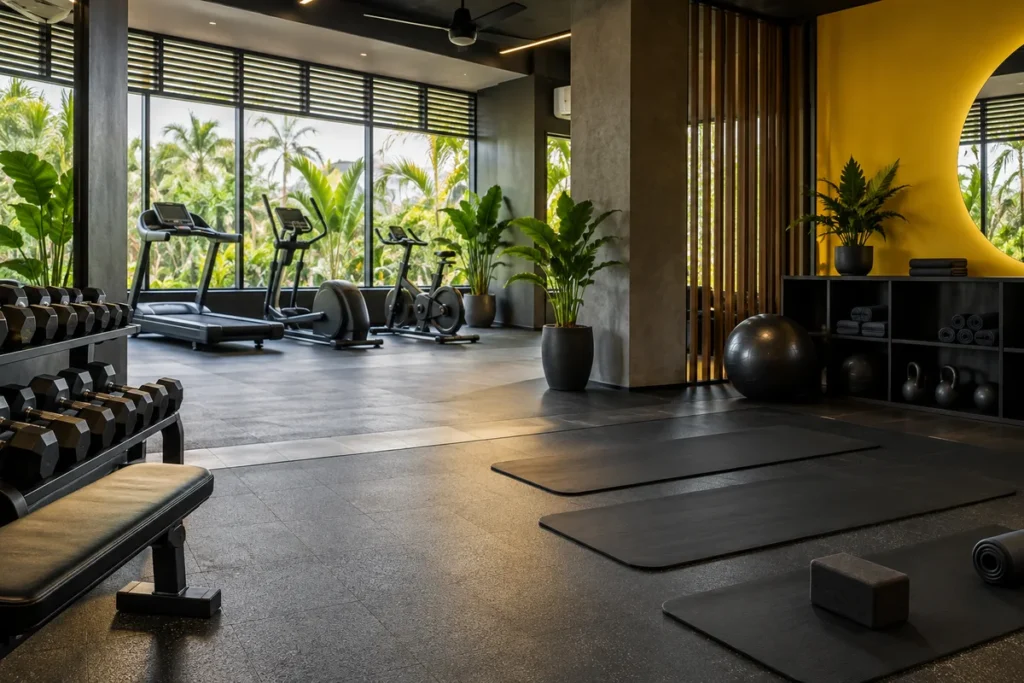
Featured image: AI-generated shared-gym concept; not a photograph of a Plus Fitness installation.
A hotel, estate or office gym should be planned around its users and the people who will operate it. Start with expected demand, supervision and maintenance responsibility, then choose equipment that fits the room and its intended use. Buying the largest package that fits the floor plan can leave you with queues, awkward circulation and machines nobody has time to look after.
The right plan is usually more specific than “a small commercial gym”. A hotel serves changing guests, an estate serves a more consistent resident group, and an office must fit around the working day. Those differences should shape the brief.
Three shared facilities, three different questions
For a hotel, ask how a first-time guest will understand the room. Equipment settings, access rules and fault reporting should be clear without requiring someone to know the building. Consider how the gym operates when the staff member most familiar with it is off duty.
For an estate, establish who owns the operating decisions. Residents may have different training interests, but a committee still needs one person or team accountable for cleaning, service bookings and purchases. A suggestion box is useful; it is not a maintenance system.
For an office, ask when people are actually likely to train and what facilities support them. Changing arrangements, access outside normal hours and the relationship between the gym and nearby workspaces may matter as much as another machine. Do not treat equipment provision as evidence of a health outcome or employee benefit unless you have measured it appropriately.
| Facility | Planning question | Buying implication |
|---|---|---|
| Hotel | How will unfamiliar users find instructions and help? | Prioritise clear adjustments, visible guidance and an agreed support process |
| Estate | Who manages use and maintenance between committee meetings? | Assign an operator and reserve an ownership budget |
| Office | When will demand concentrate, and who can access the room? | Plan around the likely peak period and building arrangements |
These are starting points, not fixed equipment lists. A small supervised estate gym may need a different mix from a larger unsupervised hotel facility.
Estimate simultaneous demand before counting machines
The number of residents, rooms or employees is not the number of people who will train at once. Ask about likely usage periods and record the assumptions. If no reliable information exists, use a modest initial proposal with room to adapt after opening.
Think in activities. How many people may want cardio together? Will anyone need space for a coached session? Can another user retrieve weights while a station is occupied? Avoid counting a multifunction machine as several independent stations if only one person can use its functions at a time.
A useful planning exercise is to walk through a busy session on paper. Mark where each user begins, adjusts equipment, stores belongings and moves next. This often reveals a bottleneck that a product count misses.
You do not need to forecast usage with false precision. Write “assumed busiest period: after work; demand to be reviewed after opening” if that is the current evidence. It is better than designing around an unexplained number.
Choose equipment for the agreed use class
Shared use can mean repeated adjustments and many different users. Ask for written confirmation that each model is suitable for the intended facility and its operating pattern. “Heavy duty” in an advertisement is not a complete use classification, nor does it establish warranty coverage.
For cardio equipment, compare access, adjustment range, controls, stopping arrangements and the manufacturer’s operating requirements. For strength equipment, consider how users select resistance, change positions and recognise whether a setting is secure. Ask for demonstrations using the exact models proposed.
Pin-loaded machines allow resistance to be selected from a built-in stack; plate-loaded machines require users to add and remove compatible plates. Neither system makes every exercise or user automatically safe. Supervision, instructions and model suitability remain important. The same applies to free weights: they can be useful, but need suitable storage and an operating plan.
Use the cardio range and strength range as a shortlist, then ask Plus Fitness to identify the models that match your brief rather than assuming all products are interchangeable.
Leave room for users, access and maintenance
A layout must show more than equipment footprints. Include the manufacturer’s operating and servicing clearances, access to controls, storage, circulation and building escape routes. A competent site professional should resolve building and access requirements.
Consider whether people with different mobility or access needs can enter and use the facility. Consult users where practical instead of assuming that one accessible item makes the whole room inclusive. Sport England’s inclusive facilities guidance is a useful reference for considering access throughout a facility; it is not a statement of Nigerian legal requirements.
Keep the operational layout realistic. If staff must move a bench every time they open a cupboard, the storage plan needs attention. If a technician cannot reach a service panel without dismantling neighbouring equipment, future maintenance may be more disruptive than expected.
Make the building part of the equipment decision
Before ordering, confirm the floor, electrical supply, ventilation and delivery route with the appropriate people. Heavy equipment and concentrated loads require site-specific assessment where relevant. Equipment on an upper floor also raises handling and noise questions that should not be left to delivery day.
For powered machines, obtain the exact electrical requirements and have a qualified electrician assess the proposed supply and any backup system. Do not assume a machine will work with an existing inverter simply because another appliance does.
Describe environmental conditions accurately. A sealed air-conditioned room differs from a partly open space exposed to moisture and dust. Request the manufacturer’s permitted installation environment and cleaning guidance. Avoid promising that indoor equipment will tolerate outdoor conditions without supporting documentation.
Assign the daily work before opening
A shared gym needs a named person or team for opening checks, cleaning, fault reporting and service records. Define who can take equipment out of use and who can authorise its return. That authority should remain clear even if the facility is operated by a contractor. Put these decisions into a written project brief, including the flooring plan. When choosing strength equipment for shared use, compare pin-loaded and plate-loaded machines, then assign responsibility for the maintenance log.
Keep user reporting simple. A visible contact point and an equipment identifier help a guest or resident report “bike 02 has a loose pedal” rather than “something is wrong in the gym”. Do not ask users to investigate or repair faults.
Planned maintenance should follow the relevant manufacturer’s instructions and account for use and conditions. HSE’s maintenance guidance supports using competent people and keeping equipment maintained; its UK legal framework should not be presented as Nigerian law.
Build the ownership budget around actual responsibilities. Cleaning materials, replacement wear parts, servicing and staff time should have an owner. A purchase budget that ends at opening day leaves the facility vulnerable to small problems becoming long periods of downtime.
Agree a handover that staff can use
At handover, collect the invoice, exact model and serial details, manuals, warranty terms and support contacts. Ask the supplier to demonstrate adjustments, ordinary checks and stopping controls where relevant. Keep this separate from coaching users through exercise technique.
Ask staff to explain the fault-reporting procedure back in their own words. If they cannot identify who to call, where to record an issue or who may reopen a machine, the operating process is not ready even if assembly is complete.
A practical opening folder contains:
- The approved equipment list and layout.
- Manuals and product-specific warranty information.
- Asset identifiers and serial numbers.
- Cleaning instructions and approved material choices.
- Inspection and service responsibilities.
- A fault log and escalation contacts.
- The facility’s access and supervision arrangements.
Keep personal information out of shared maintenance records unless it is necessary for the task and handled appropriately. Most equipment faults can be recorded without documenting a user’s health or identity.
Review use before expanding
After opening, record simple observations: which equipment is frequently occupied, what users ask for, which adjustments cause confusion and what faults recur. Use those observations to refine the plan. They are more useful than buying additional equipment solely because there is an empty corner.
Distinguish demand from availability. A machine may appear unpopular because it is difficult to adjust, poorly positioned or awaiting repair. Resolve those issues before concluding that the activity is unwanted.
For the broader purchasing process, see the commercial gym equipment guide. To discuss a shared facility, send Plus Fitness the room measurements, intended users and operating plan. Ask for a proposal that identifies equipment suitability, clearances, service scope and the responsibilities your organisation must retain.
Prepared with AI assistance. Sources and product links checked on 18 September 2026.
Pingback: Pin-Loaded vs Plate-Loaded Gym Machines | Plus Fitness