
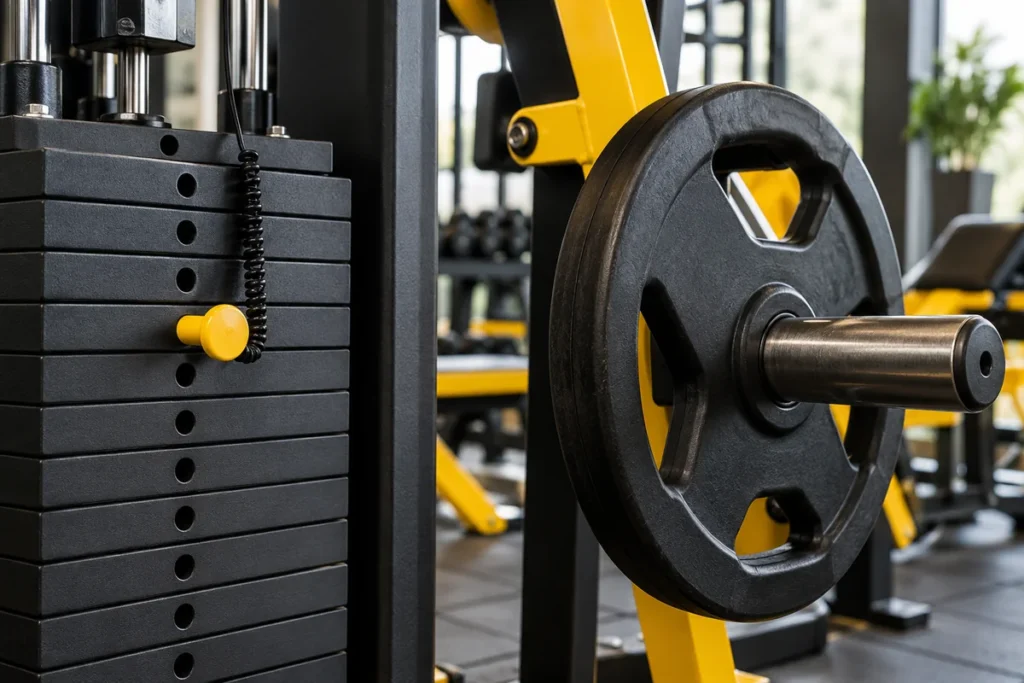
Featured image: AI-generated comparison concept; the machines are illustrative and not identified product models.
Pin-loaded and plate-loaded machines organise resistance differently. A pin-loaded machine usually has a built-in weight stack selected with a pin. A plate-loaded machine uses removable weight plates on designated loading points. Choose between them by considering the users, adjustment process, plate handling, available space and support for the exact model.
Neither design is automatically better, safer or more effective for every shared gym. A hotel facility, a coached strength studio and an estate gym may arrive at different choices because their users and operating arrangements differ.
Compare the whole user task
On a pin-loaded machine, a user typically adjusts the seat or supports and selects a stack setting according to the instructions. On a plate-loaded machine, the user must also select, carry, load and remove compatible plates. That extra task may be acceptable or desirable in one facility and a practical obstacle in another.
Look beyond the resistance change. Can the intended users enter the machine, reach the controls and understand the adjustment points? Can staff explain the setup clearly? Does the machine accommodate the range of users expected?
A guided movement path does not guarantee that a machine fits everyone. A qualified coach can help assess exercise suitability and user setup; the supplier should establish the product’s adjustment range, intended use and installation requirements.
A practical comparison
| Decision | Pin-loaded machine | Plate-loaded machine |
|---|---|---|
| Resistance selection | Built-in stack with model-specific increments | Compatible plates assembled on designated loading points |
| Loose equipment | Usually less plate handling for that station | Plates and suitable storage must be planned |
| Changeover | Can be straightforward when controls are clear | Includes loading and unloading as well as seat adjustments |
| Expansion | Limited by the approved stack and design | Limited by the manufacturer’s loading rules and physical capacity |
| Maintenance | Depends on the model’s moving parts and transmission | Also depends on the model; absence of a stack does not mean maintenance-free |
This comparison describes common arrangements, not a specification for every machine. Some designs have additional adjustments or loading features that need their own review.
Do not compare resistance numbers as if they were identical
A number on a weight stack and the mass of plates on a lever machine do not necessarily describe the same resistance experienced through a movement. The mechanism and geometry affect how the machine behaves. Avoid promising that two different machines provide equivalent resistance merely because their displayed kilograms match.
Compare the intended exercise, adjustment range and usability instead. If performance characteristics are important to a purchase, request the manufacturer’s technical information and an appropriate demonstration. Do not infer a machine’s training effect from a photograph or its maximum loading number.
For plate-loaded machines, distinguish load per horn from total permitted load. Ask whether the manufacturer specifies balanced loading, compatible plates or limits for particular positions. For a stack machine, do not add external weights or alter the stack unless the manufacturer explicitly permits the method.
Count the space around the machine
The equipment footprint is only part of the floor area needed. Include moving components, user entry and exit, adjustment access, servicing and the manufacturer’s clearances. For plate-loaded equipment, also show where plates are stored and how users reach them.
A storage tree placed beside a machine can still obstruct a walkway or a moving arm. A built-in storage horn can also extend the effective footprint. Add these details to the layout before comparing how many stations fit in a room.
In a shared facility, imagine one person using the machine while another passes or collects equipment. If those activities conflict, the layout needs attention. Do not solve the conflict by removing a manufacturer-required clearance.
Check the actual catalogue examples
The 45 Degree Leg Press is an example to discuss when considering a plate-loaded strength station. Ask for the exact model’s dimensions, user and loading limits, stopping or locking arrangements, compatible plates and installation instructions. The catalogue photograph is not enough to establish those details.

For a broader shortlist, browse the Plus Fitness strength category and ask which machines fit the facility’s users and supervision model. Compare individual models rather than assuming every product in a category has the same commercial-use approval.
Where a model’s manual is needed, obtain it from the supplier or manufacturer. Manufacturer support libraries such as Life Fitness Support illustrate why documentation should be matched to the exact product; they are not evidence for the specifications of an unrelated machine.
Include the supporting purchases
A plate-loaded quotation should identify which plates and storage are included. Check plate compatibility and the useful spread of weights. A machine price without its required plates cannot be compared directly with a complete pin-loaded station. For a shared facility, connect the machine decision to the operating plan and maintenance log. Check plate compatibility rather than assuming existing weights will fit, and compare the role of dumbbells before allocating the whole strength budget.
A stack machine may include its resistance but still need delivery, assembly, installation or accessories. Ask for the same scope on both quotations, including placement in the final room and the handover process.
Think about shared resources. If several machines depend on one small set of plates, users may spend time moving weights between stations. If you buy a complete plate allocation for each machine, the cost and storage requirement change. Make that decision deliberately rather than discovering it after opening.
Ask about maintenance and parts
List the parts and procedures relevant to the exact model. Depending on its design, a machine may use cables, belts, pulleys, bearings, guide rods, adjustment pins or upholstery components. Do not assume a plate-loaded design has nothing to service, or that every pin-loaded machine uses the same cable arrangement.
Request the maintenance instructions, support contact and availability process for wear parts. Ask who can carry out the work in your location and what information they need to identify the machine. A serial number and photographs can be more useful than a general description such as “the chest machine”.
Keep faults and service actions in the facility’s records. For broader ownership planning, see the existing gym equipment maintenance guide. Always use the model’s documentation for actual procedures and intervals.
Match the decision to the facility
For a hotel with changing users, clear instructions and understandable adjustments may be a high priority. For a coached strength facility, staff may be comfortable managing plate handling and more specialised stations. An estate or office should consider the range of users and who will supervise or explain the equipment.
These are planning considerations, not rules that one facility type must buy one resistance system. A mixed setup can be sensible when each item has a clear role and the layout supports it.
Before ordering, write down the reason for the choice: the activities supported, the users accommodated, the complete cost and the ownership arrangements. If the explanation rests only on appearance or the word “commercial”, the comparison is not finished.
Ask Plus Fitness to compare suitable strength machines for your shared gym. Include the room measurements, expected users, supervision arrangements and whether you already own plates that you hope to reuse.
Prepared with AI assistance. Sources and product links checked on 18 September 2026.
Pingback: Plan a Hotel, Estate or Office Gym | Plus Fitness