
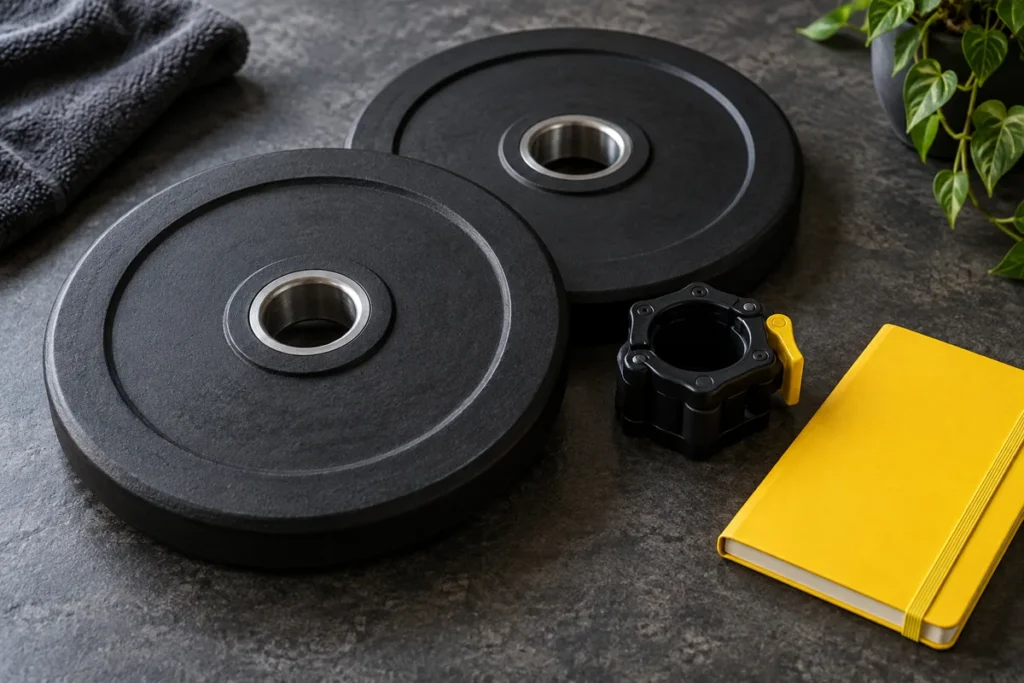
Featured image: AI-generated equipment concept; use documented product measurements to establish compatibility.
Before buying a barbell, plates and collars, confirm the sleeve diameter, the plate-hole size, the collar system and the permitted load for the exact equipment. “Standard” and “Olympic” are useful catalogue labels, but they are not a substitute for checking the dimensions and specifications of the items you intend to combine.
Compatibility is a chain. A plate must fit the bar; a collar must secure it as intended; the loaded bar must be suitable for the rack and activity. One matching measurement does not answer every part of that chain.
Distinguish the shaft from the sleeves
The shaft is the part of a bar you grip.
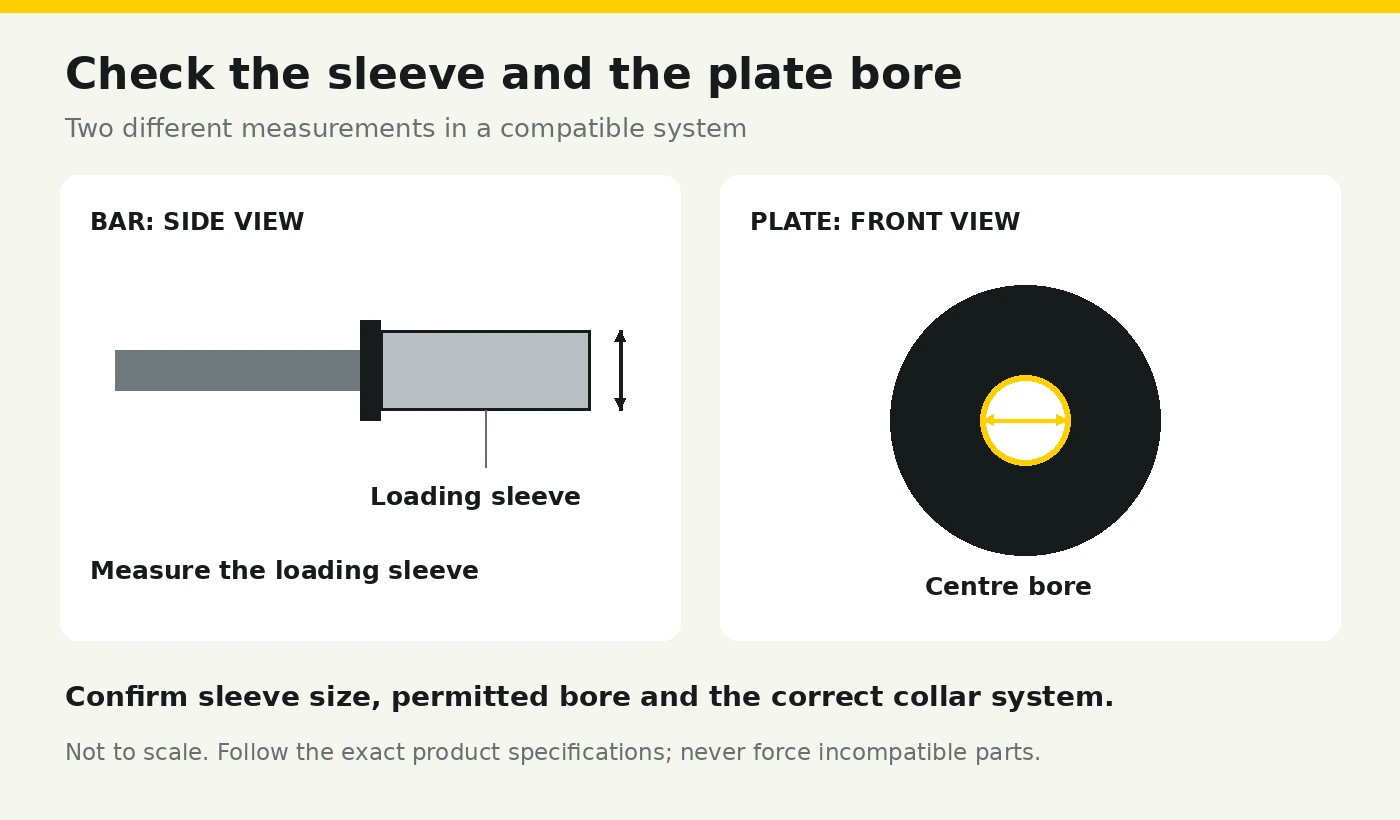
The sleeves are the sections at the ends where plates are loaded. Their diameters serve different purposes, so a measurement of the grip does not tell you which plates or collars to buy.
Record the sleeve diameter from the product specification. If a measurement is needed, have it taken accurately and confirm the result with the supplier. Do not estimate from a photograph or from the overall size of a plate.
For a threaded or spin-lock system, the collar must match the intended thread and handle or bar. A clamp intended for a smooth sleeve is a different arrangement. Avoid using an improvised collar because it appears to grip temporarily.
Check the plate bore and the complete collar system
The bore is the hole through the centre of a plate. It must be compatible with the sleeve. A plate that can be slid onto a bar is not necessarily a correctly matched plate if the fit is excessively loose or the manufacturer does not permit the combination.
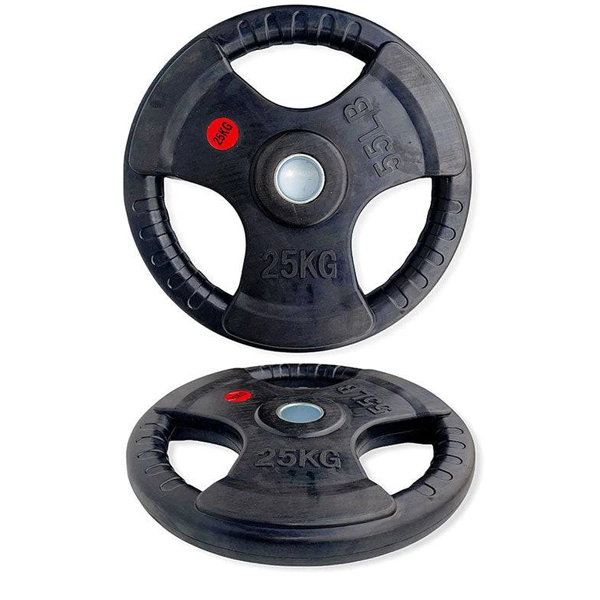
The Olympic Weight Plates and Barbell Collar Clamps in the Plus Fitness catalogue are described for two-inch Olympic sleeves. Treat that as a starting point and confirm compatibility with the exact bar on your quotation. Do not apply that description to other plates or collars whose specifications have not been confirmed.
Keep collars in pairs where the equipment requires them, and follow the bar and collar instructions for use. A missing or damaged collar should trigger a replacement enquiry, not an improvised repair.
Compare the measurements that solve different problems
| Measurement or specification | What it helps establish |
|---|---|
| Sleeve diameter | Compatible plate bores and collar systems |
| Loadable sleeve length | Space available for plates and the required collar arrangement |
| Distance between sleeve shoulders | Whether the bar sits appropriately on the intended rack |
| Overall bar length | Room and handling requirements |
| Bar mass | The unloaded contribution to the total weight |
| Manufacturer’s load and use limits | Whether the intended activity and loading are permitted |
Ask the supplier to distinguish overall sleeve length from usable loading space. Part of the sleeve may be needed for the collar, and plate thickness varies. A set can have a suitable total mass yet occupy more space than the sleeves allow.
Do not compare bars only by an advertised maximum load. Ask what that rating covers and what activities the manufacturer permits. A general-purpose bar, a specialised lifting bar and a short bar may have different intended uses even when their plates fit.
Make a loading plan before ordering a set
Write down the combinations you intend to assemble and the plates needed on each side. Include the bar’s own mass. This makes it easier to spot a package with plenty of total weight but an inconvenient spread of plate sizes.
For example, if a confirmed 20 kg bar is loaded with one 10 kg plate on each side, the bar-and-plate total is 40 kg before accounting for any collars. This is arithmetic, not a recommendation about the weight a person should lift. The actual bar mass and components must be verified for the equipment purchased.
If you already own plates, send the supplier their measured bore, thickness, markings and photographs. Ask whether they are suitable for the proposed bar and use. Buying a new bar is not a reason to assume every existing plate can be retained.
Check rack compatibility separately
The distance between the rack’s supports must suit the usable shaft area of the bar. A shorter bar may accept your plates but not sit correctly on the rack. Confirm the rack and bar dimensions together, including the manufacturer’s instructions for the supports and safety equipment. Use the rack and power-cage checklist for the surrounding setup. If you are comparing a barbell purchase with a smaller free-weight arrangement, the adjustable versus fixed dumbbell guide covers storage, increments and changeover.
Also consider room width. You need access to load and unload the ends without forcing people into walls, mirrors or circulation routes. The equipment manufacturer’s clearances and a competent layout assessment should guide the arrangement.
Browse strength equipment and the weights range together when planning a new setup. A rack, bar and plate list should be checked as a system rather than as three unrelated purchases.
Do not infer impact suitability from the coating
A rubber-coated plate and a plate designed for a particular dropping activity are not automatically the same product. Ask for the manufacturer’s permitted use for the exact plate, bar and flooring system. Rubber on the outside is not enough evidence to approve dropping a loaded bar.
The same caution applies to photographs of equipment in a commercial gym. Appearance does not establish the permitted activity, the installation beneath it or the conditions attached to the product warranty.
If your intended training involves impact, tell the supplier before selecting the equipment. Obtain a documented recommendation covering the complete setup and involve the appropriate coach and site professionals where needed.
Inspect the equipment without improvising repairs
Before use, follow the manufacturer’s checks for the bar, collars and plates. Visible damage, a locking problem or an unexplained change in behaviour should be reported and assessed before further use. Do not straighten a bent bar, alter a plate hole or modify a collar to force compatibility.
For shared equipment, record defects against an asset identifier so another user does not unknowingly pick up the same item. HSE’s equipment inspection guidance supports checks informed by the equipment, use and conditions; it does not prescribe one universal schedule for every gym item.
Store plates and bars using suitable equipment within its stated capacity. Confirm storage compatibility too: a storage peg, wall fitting or rack needs its own assessment and installation instructions.
Send a compatibility enquiry that can be answered
Instead of asking “Will these plates fit?”, provide the model names or links and the measurements you have. State the intended rack and activity, whether components are new or already owned, and which specifications remain unknown.
A useful enquiry includes:
- Bar model, sleeve diameter, usable sleeve length and mass.
- Plate model, bore size, thickness and quantities.
- Collar type and intended bar compatibility.
- Rack model and support dimensions, if a rack is involved.
- Intended use, storage and any installation constraints.
Ask Plus Fitness to confirm the combination in the written quotation. Contact the team with the relevant product links and measurements before ordering separate components that may not work together.
Prepared with AI assistance. Sources and product links checked on 18 September 2026.
Pingback: Squat Rack or Power Cage? Space and Buying Checks