
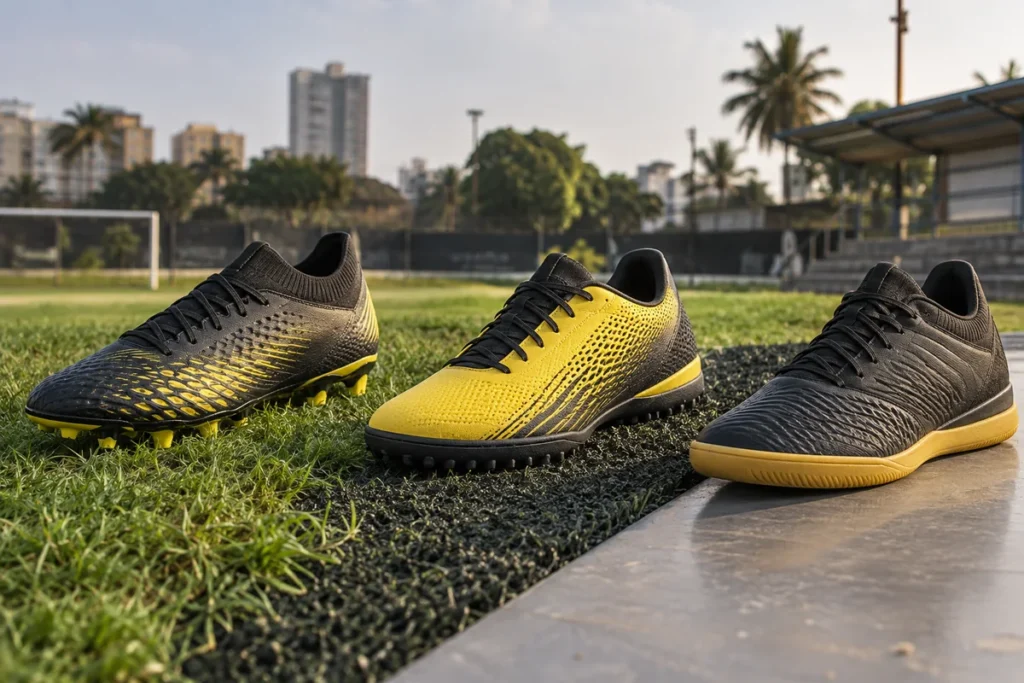
Featured image: AI-generated footwear illustration; use the exact manufacturer’s surface guidance, not the illustration, to choose a shoe.
Choose football footwear for the surface you actually play on, then check fit and the exact model’s intended use. Natural grass, long-pile artificial grass, short artificial turf and a hard court are different surfaces. A boot’s colour, player endorsement or family name does not tell you whether its outsole suits your pitch.
If you alternate between surfaces, list them before shopping. The phrase “multi-ground” still needs to be checked against the manufacturer’s guidance and the venue’s rules for the particular shoe.
Identify the surface first
Ask the venue how it describes the playing surface and what footwear it permits. “Astro”, “turf” and “artificial grass” are often used loosely in conversation. A clear photograph and the venue’s guidance can help a retailer understand what you mean, but the product specification remains essential.
For natural grass, note the normal condition rather than the best day of the season. For a hard court, establish whether the venue requires a particular non-marking outsole. Do not assume a studded boot is acceptable because the game is football.
If the surface is damaged or unsuitable for play, footwear is not a solution to the venue problem. Raise the condition with the organiser rather than looking for a sole that supposedly makes any pitch safe.
Understand the labels without treating them as guarantees
Manufacturers use surface labels to distinguish outsole designs. The following is a reading aid for a shortlist, not permission to use every shoe in a category on every similar-looking surface.
| Label commonly used | Surface category to confirm |
|---|---|
| FG, firm ground | Appropriate natural-grass conditions for the exact model |
| AG, artificial grass | The artificial-grass surfaces specified by the manufacturer |
| MG, multi-ground | The particular range of surfaces approved for that shoe |
| TF or turf | Usually shorter, firmer artificial-turf applications, subject to model guidance |
| IC, IN or indoor | Court use as specified; check the venue’s outsole rules |
Nike’s football boot guide distinguishes these surface families. Its advice applies to its products, and model-specific instructions take priority over a general label. Avoid treating any abbreviation as a universal standard shared identically by every brand.
Check the exact version of the boot
A familiar boot family can contain different tiers, generations and outsole versions. Ask for the full product name, style or model code, size and sole designation. Make sure the photograph and the item being supplied refer to the same version.
For example, the Nike Air Zoom Mercurial Football Boot is listed in the Plus Fitness catalogue. Before ordering, ask the team to confirm the exact version, outsole designation and available size. The family name alone does not establish that it suits your playing surface.

Do not infer authenticity, specification or suitability solely from a logo in a photograph. Buy through a source that can provide clear product identification and an invoice, and resolve any mismatch before use.
Fit matters after surface suitability
Try the footwear with the socks you intend to use where a fitting is available. Assess both feet and follow the manufacturer’s size guidance. A familiar size in a different brand or generation may not fit identically.
Check comfort, secure retention and whether there is unwanted movement or pressure. Do not buy a painful fit on the assumption that it must become suitable after several matches. If a foot condition or persistent pain affects your choice, seek appropriate professional advice rather than relying on a retailer to diagnose it.
For children, review fit as they grow. Buying a much larger shoe to extend its life can create a different fit problem. The appropriate size should be assessed for the child and the product, not selected only from an age label.
Ask the organiser about equipment rules
Venue and competition rules can restrict footwear or particular stud types. Check before purchase if you play in an organised league, school competition or hired facility.
IFAB Law 4 requires players’ equipment to be safe and includes footwear among compulsory items. It does not certify that a particular retail boot is suitable for every pitch. Match officials and organisers may have additional requirements relevant to the event.
Avoid promises that a specific outsole prevents injury. Footwear selection is one part of participation, alongside the surface, activity, fit and other factors. A buying guide should not turn a marketing claim into a medical guarantee.
Plan for more than one surface honestly
If most sessions are on one surface and occasional games are elsewhere, explain that pattern to the retailer. A suitable multi-ground option may cover some combinations, but only where the exact model’s guidance permits it. Otherwise, separate footwear may be the more appropriate solution.
Do not assume that a more expensive boot is more versatile. A specialised model may be designed for a narrower use than a less expensive alternative. Compare the approved application before comparing the tier or price.
For a team order, collect individual sizes and surface requirements before requesting a bulk quote. One attractive style should not override different fit needs or the actual venue specification.
Care for the outsole and upper as instructed
Follow the manufacturer’s cleaning and drying guidance. Remove dirt using the permitted method and inspect the footwear for damage before use. Do not alter studs or fit replacements unless the product is designed for them and the correct components are specified.
Keep the original product identification and purchase record. If the sole separates, a stud is damaged or another fault develops, stop using the affected footwear and ask the seller or manufacturer for advice. Do not assume a glue repair preserves the original performance or warranty.
Check the Plus Fitness warranty and returns policy before purchase and ask how fitting or product issues should be handled. Confirm any product-specific conditions rather than assuming worn footwear can be exchanged simply because the size was guessed.
What to send when asking for help
Provide the venue’s surface description, any footwear rules, your size information and the exact product link you are considering. If you play on more than one surface, list each one. A photograph of the outsole you currently use can help explain the question, but it should not replace the new product’s specification. If you are buying the rest of the kit, check the football’s size, surface and inflation requirements separately. Schools and clubs can use the PE equipment procurement checklist to turn individual choices into a clear group order.
Browse the Plus Fitness sportswear and footwear range or contact the team to confirm a suitable available option. Choose the surface and fit first; let colour and style decide between models that already meet those requirements.
Prepared with AI assistance. Sources and product links checked on 18 September 2026.
Leave a Reply