
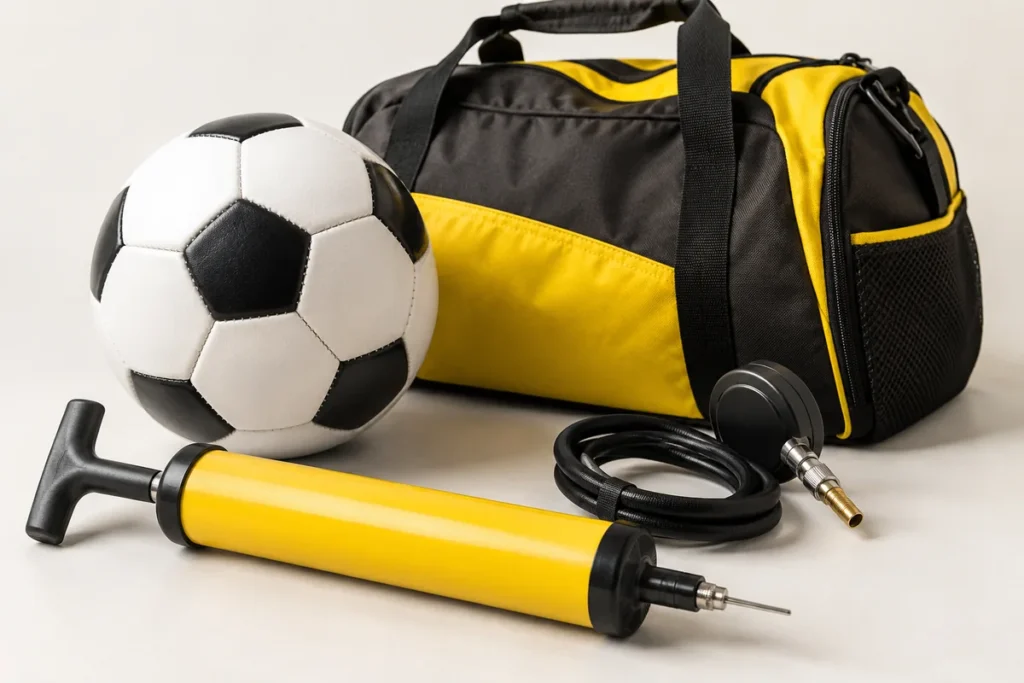
Featured image: AI-generated equipment still life; no pressure reading or product certification is represented.
Choose a football by the game, the players and the surface, then confirm its size, construction and inflation instructions. For a school, club or casual group, the right ball is one that matches the intended activity and can be maintained consistently. A familiar tournament-style design is not enough to establish its specification.
Before buying several, confirm one exact model. Record what is being supplied so later replacements can be compared with the same requirements.
Start with the rules for the activity
Ask the organiser which ball size and specification apply. Adult association football, youth activities and futsal should not be treated as the same purchasing brief. A smaller ball is not automatically a futsal ball, and an adult match specification should not be applied to every school age group.
For the standard ball under IFAB Law 2, the specified circumference is 68–70 cm and the mass at the start of the match is 410–450 g. Those figures describe that rules context; confirm the appropriate requirements for your own age group or competition.
If the purchase is for informal practice, describe the players, activity and surface to the supplier. Avoid choosing by a size number alone when the intended use remains unclear.
Check the surface claim for the exact model
Tell the seller whether the ball will be used on natural grass, artificial turf, a hard court or a mix. Request the manufacturer’s intended-use information for the product. A general “all-surface” description deserves clarification about the conditions and any restrictions.
Hard or abrasive surfaces can present a different ownership problem from a maintained grass pitch. Ask what use the cover is designed for and what care is required. Do not assume a premium match ball is the most economical choice for every training environment.
For a team or school, distinguish match requirements from routine practice. You may need a consistent training set and a separate competition-approved ball. Keep that distinction in the order rather than buying an assortment that changes the session each time a different ball is used.
Understand what the bladder description does—and does not—tell you
The bladder is the internal part that holds air. Listings may identify materials such as butyl or latex, but the material name alone does not establish the complete ball’s pressure retention, feel or maintenance needs. The construction, valve and manufacturer’s design all matter.
Ask for the model’s inflation and storage instructions, and what pressure checks the manufacturer recommends. Do not promise a fixed number of days between pumping based only on a bladder material. Actual condition and use can differ.
For a shared kit, consistent pressure checks can be more useful than chasing a material claim that has not been documented. Assign someone to check the balls using the correct instructions before the session or competition requires them.
Read the ball and packaging before inflating it
Use the manufacturer’s marked pressure range and instructions for the exact ball. Check the units on both the ball and the gauge. PSI, bar and other units are not interchangeable numbers.
IFAB specifies a pressure range of 0.6–1.1 atmospheres at sea level for its standard ball, also expressed in the law as 8.5–15.6 psi. That is not an instruction to inflate every football to the upper limit. The relevant rules and the ball manufacturer’s permitted range must both be satisfied. Source: IFAB Law 2.
Use a suitable pump, needle and pressure gauge, following the ball maker’s directions. Do not force an unsuitable needle into the valve or guess inflation by appearance alone. If instructions call for a particular needle preparation, follow those instructions rather than using an arbitrary oil or household product.
Compare a complete football purchase
| Item to confirm | Why it matters |
|---|---|
| Exact model and size | Keeps the order aligned with the activity and rules |
| Intended playing surface | Establishes the appropriate application |
| Construction and bladder information | Helps identify the product and its care requirements |
| Printed inflation range | Gives the correct basis for pressure checks |
| Pump, needle and gauge | Makes consistent preparation possible |
| Storage and quantity | Supports the planned sessions and replacement process |
The Select Football and Afc Molten Football are catalogue examples to discuss with Plus Fitness. Confirm the exact model, size, construction, surface suitability and inflation markings of the item supplied. A brand or listing name alone is not enough to infer a particular competition approval or bladder material.
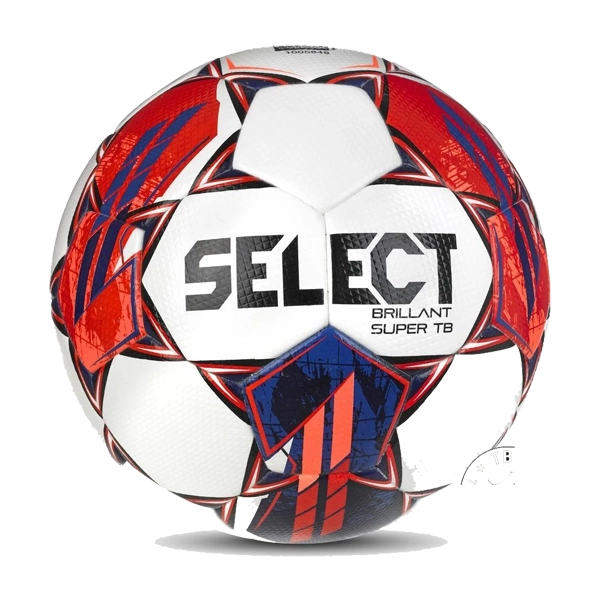
Do not infer certification from the artwork
A ball can resemble a well-known match design without carrying the same tested specification. If a competition requires an approval mark, verify the exact product and relevant requirement through the organiser and manufacturer. Do not treat a printed competition name as proof of approval.
Ask for current photographs of the markings where the order depends on them. Keep the invoice description specific, especially for a bulk purchase. If the delivered model differs, resolve the substitution before distributing it as the approved match ball.
Inspect and care for the ball
Follow the manufacturer’s cleaning, drying and storage instructions. Check for visible damage, unusual deformation or a valve problem before use. A ball repeatedly losing pressure should be assessed rather than simply pumped harder each time.
Do not leave care to whoever last used the equipment. For a club or school, keep a straightforward issue-and-return process and a place for items needing attention. Separate a damaged ball from the usable set so it does not return to circulation by mistake.
When several balls are used together, record the model and pressure-check process consistently. This helps teachers and coaches plan sessions without avoidable variation caused by incomplete preparation.
Decide how many you need from the session plan
Count the pairs, groups or stations that need a ball at the same time, then consider a proportionate replacement arrangement. Do not buy an arbitrary large bundle simply because the unit price looks attractive if the size or surface specification is wrong. Match the ball order to the wider school or group equipment plan. Players should also check football footwear for the actual surface; choosing a suitable ball does not establish that their boots are suitable too.
A school preparing three activity stations may need a different distribution from a club running a full-team session. The teacher or coach should define that plan; the retailer can help identify products that meet it.
Before ordering, ask for the quotation to show model, size, quantity and included accessories separately. Confirm delivery, current availability and any product-specific warranty or returns conditions. No generic guide can establish those details for an order that has not yet been agreed.
Browse Plus Fitness sports equipment or send the team your ball specification. Include the players, activity, surface and organiser’s requirements so the response can address the actual purchase.
Prepared with AI assistance. Sources and product links checked on 18 September 2026.
Leave a Reply