
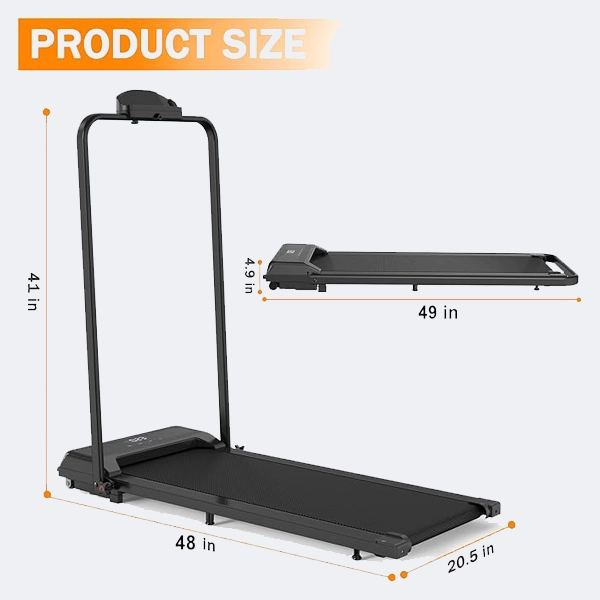
A folding treadmill saves useful space only if you can move it into its approved storage position without turning every session into a furniture-removal exercise. Compare working dimensions, folded dimensions and the route between them. All three affect whether the machine fits your home.
The photograph of a treadmill tucked neatly beside a sofa leaves out the awkward part: getting it there.
Map the route before measuring the parking space
Start at the intended training position. Follow the path to storage and note doorways, thresholds, tight turns, rugs and furniture. Establish whether the product rolls in the direction you need and whether the manual requires a particular tilt or handling method.
Next consider delivery from outside the building. An entrance gate, staircase landing or lift can be the narrowest point even when the final room is generous. The delivery and handover guide explains what to agree with the supplier about access and assembly.
Do not assume the folded dimensions are also the packed dimensions. Packaging may make the shipment larger, and permitted assembly or disassembly depends on the exact product.
Know what the folding mechanism changes
Some machines fold at the deck. Others fold their frame or handrail. Certain compact walking products have another arrangement entirely. The WalkingPad comparison demonstrates that compact models can have different storage designs and dimensions; its figures apply only to the named models.
Ask which parts move, how the mechanism locks and what clearance is needed while folding. Keep children and pets away during movement. A folded position should not be treated as safe simply because the machine can be balanced there momentarily.
Make a three-position sketch
| Position | What to draw |
|---|---|
| In use | Machine footprint, manufacturer clearances and access |
| Being moved | Turning space, required handling positions and obstructions |
| Stored | Approved orientation, stable location and any retained clearances |
This simple sketch often exposes a problem that a room's total floor area hides. A treadmill might fit under a bed but not pass between the bed frame and a wardrobe. A storage corner may block a cupboard or a route the household uses throughout the day.
Try the routine before you commit
Where a demonstration is available, watch the supplier fold and move the machine according to its manual. Assess the actual handling requirement rather than relying on a claim that transport wheels make it effortless.
Discuss who will move it at home. If two people are required and you normally train alone, a permanent operating position may be more practical. Do not attempt an unsafe lift to make a storage plan work.
The walking-pad and treadmill comparison can help you decide whether compact storage is worth changing the type of activity the machine supports. If your main requirement is running, preserve that requirement instead of choosing an unsuitable walking product purely because it disappears under furniture.
Consider the neighbours and the floor
Storage wheels do not establish whether a machine is suitable for an upstairs room. Noise, vibration and floor loading are separate issues, discussed in the upstairs gym guide. Check the flooring manufacturer's advice where repeated rolling or concentrated loads might mark the finish.
For the Plus Fitness walking-pad listing, request the exact supplied model's storage instructions and packed dimensions. Send the measured access route with your enquiry. The right folding machine is one you can store as instructed and bring out regularly without making the rest of the room difficult to use.
Pingback: Upstairs Gym Noise Vibration and Floor Checks