
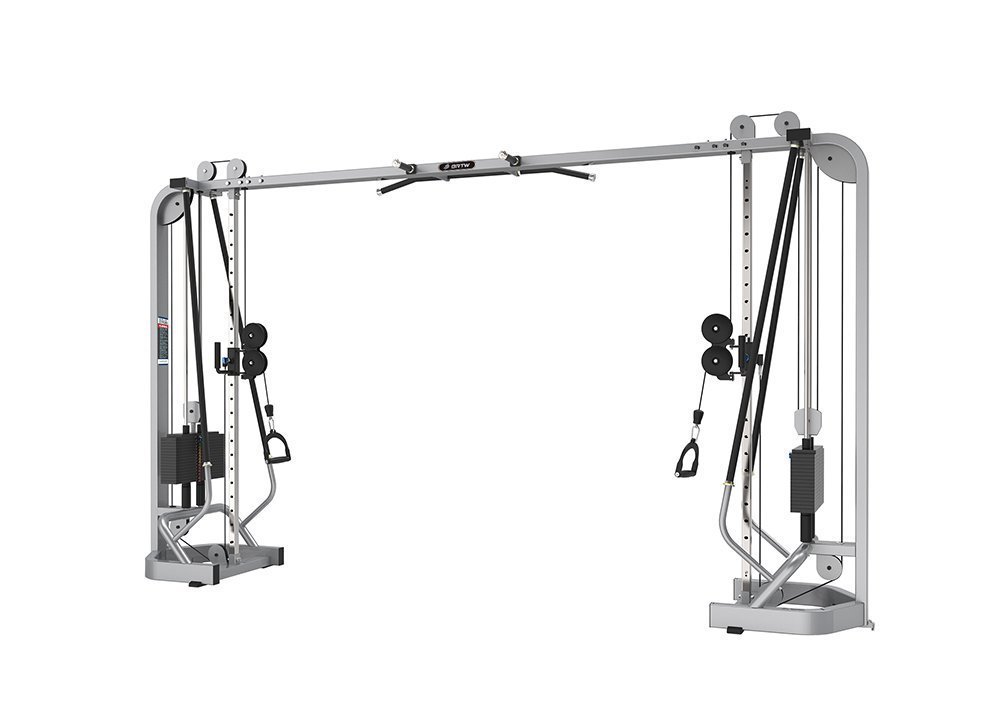
Cable machine pulley ratios help explain why the same number on two weight stacks can feel different. In a commonly described 2:1 arrangement, the handle travels about twice as far as the moving stack and the ideal resistance at that handle is about half the stack's mass-equivalent load. A 1:1 arrangement has a different relationship.
Before doing any arithmetic, establish what the manufacturer's label represents. Some markings already express effective resistance. Dividing those numbers again would produce the wrong answer.
Follow the moving load
A cable system can exchange force for distance. The user may move the handle farther while lifting the stack a shorter distance. Real equipment also has friction, acceleration and design details, so simple ratios are a useful model rather than a calibrated force measurement.
REP Fitness explains the distinction between common cable ratios. The practical lesson is to compare the documented output at the relevant handle, not simply count how many pulleys you can see. A pulley that redirects a cable does not necessarily change mechanical advantage.
Use an example carefully
Imagine two idealised machines, each with 40 kg of actual moving stack mass selected. If one outlet operates at 1:1 and the other at 2:1, their approximate static load equivalents differ. This is a simplified mechanical illustration, not a test of a stocked product.
| Arrangement | Example stack mass | Approximate ideal handle load equivalent |
|---|---|---|
| 1:1 | 40 kg | 40 kg-equivalent |
| 2:1 | 40 kg | 20 kg-equivalent |
The 2:1 arrangement also changes the relationship between handle travel and stack movement. That can be useful for movements needing more cable travel or smaller effective increments. A different configuration may suit heavier pulling requirements. Neither ratio wins every purchase decision.
Ask about each outlet
A combined machine can have different ratios at different stations. A dedicated lat-pulldown outlet may not behave like an adjustable side pulley. Two stacks may be independent, while another design shares one stack between outlets.
Ask whether the quoted resistance is per handle, per stack or a combined figure. If the manufacturer permits joining cable ends, establish the approved configuration and attachment. Do not improvise a connection to obtain a different load.
Our functional-trainer checklist connects those questions with cable travel and working space. The existing pin-loaded and plate-loaded comparison addresses the separate question of how resistance is loaded onto the machine.
Record progress on a consistent setup
Moving from one gym to another and selecting a larger printed number does not necessarily mean you have become stronger. Record the machine, station, attachment and settings along with your exercise information.
Even on the same machine, a different attachment or position can change the experience. That is not a reason to distrust every number; it is a reason to keep the context consistent. The console-readings article makes a similar point about cardio data.
Compare the useful range
For a purchase, note the lowest useful resistance, the effective change between settings, the maximum for the intended movement and the available cable travel. A larger stack may not solve the particular limitation you face.
When discussing a Plus Fitness adjustable cable machine, ask for the documented ratio and labelling method at each outlet you intend to use. A clear answer allows you to compare equipment meaningfully instead of paying for the biggest number in the description.
Leave a Reply