
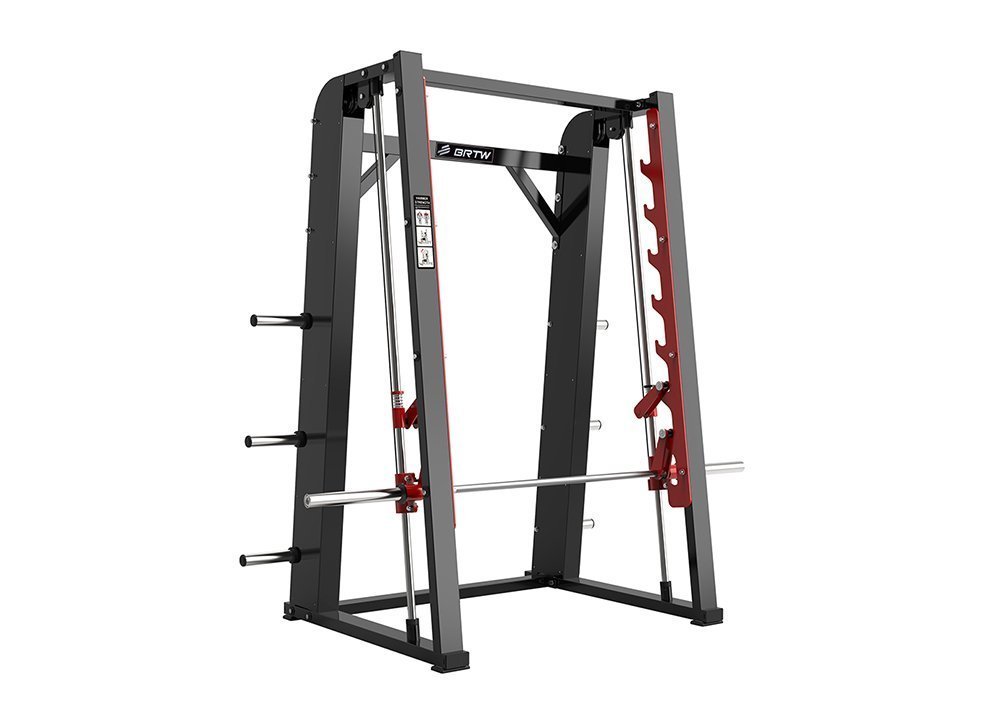
A Smith machine guides a bar through the path allowed by its design. A power rack supports free-barbell work using compatible hooks and safety equipment. Choose between them according to the movements you want to perform, the users, the room and the instruction available.
The choice is often described as convenience versus freedom. In practice, the setup details matter more than that slogan.
Understand the path before comparing the load
Many Smith machines guide the bar on rails, which may be vertical or angled. Other designs permit additional movement. Ask the supplier to explain the exact mechanism rather than assuming every product called a Smith machine behaves identically.
On a free-barbell setup, the user controls the bar's path. The rack provides support at the start and finish and can incorporate properly configured safety equipment. It does not choose the movement for the user.
Neither arrangement removes the need for instruction, appropriate loading and the correct setup. Avoid claims that a guided bar prevents injury or that free weights are automatically unsuitable for beginners.
Check the actual exercises
Ask a competent coach to help evaluate the movements you intend to perform. Can the bench be positioned correctly? Do the starting height and available travel suit the users? Are the bar's controls, catches or safeties accessible in the required positions?
With a Smith machine, request the bar's stated starting resistance and any counterbalance information. A bar that looks like a standard free barbell may not have the same effective starting load. With a rack, confirm the bar, bench and safety compatibility using the existing rack and power-cage guide.
Plan the whole footprint
| Setup detail | What to include |
|---|---|
| Loading plates | Space beyond the frame to handle plates comfortably |
| Bench position | Room to move and adjust it for the intended exercises |
| Safeties and catches | Access and the manufacturer's required setup |
| Plate storage | Usable storage without obstructing movement |
| Installation | Floor or wall requirements and approved fixing method |
A combined machine can offer several functions in one frame. That does not mean every function is available simultaneously. If two people will share it, use the functional-trainer checklist to examine cable positions and conflicts as well.
Compare support and compatibility
For a rack, an existing barbell may fit or may require replacement. The barbell-detail guide covers grip and sleeve rotation, while the current compatibility guide addresses the measurements that decide whether parts work together.
For a Smith machine, moving components and proprietary parts deserve particular attention. Ask how the model is identified and how replacement parts are obtained. Manufacturer resources such as the Body-Solid manual library illustrate why instructions should be tied to a named model rather than a generic product category.
Use the demonstration to choose
Try the normal setup process under appropriate guidance, including positioning, loading and adjustment. Consider whether the people who will use the equipment can repeat that process consistently.
Plus Fitness lists a Smith machine alongside rack options. Send your intended movements and room measurements when requesting a comparison. A suitable machine is one whose movement path, setup and support match the way you plan to train, with its limitations understood before it becomes the centrepiece of the room.
Leave a Reply