
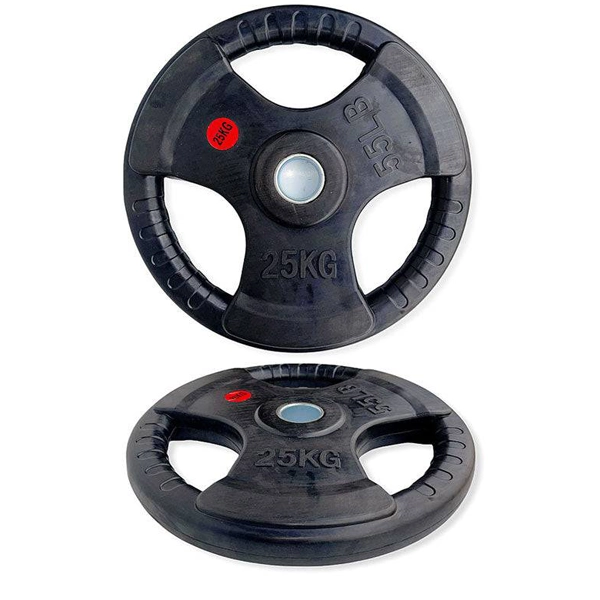
Bumper plates are designed as a category for particular impact-related lifting uses, while iron plates are commonly chosen where compact loading and controlled placement are priorities. Rubber-coated plates are not automatically bumper plates. Establish the exact product's permitted use before deciding how it may be handled.
The coating is what you see first. The construction and instructions determine what the plate is intended to do.
Separate appearance from purpose
A rubber surface can protect the plate or make handling more pleasant without making the product suitable for dropping. A bumper plate has a different design purpose, but its permitted use still depends on the manufacturer's instructions, the bar, the load and the training surface.
Rogue's plate guide distinguishes bumper and metal plate families. Use that distinction to ask better questions, not to assume that every product with a similar colour or diameter meets the same requirements.
If your programme includes lifts where a loaded bar may be dropped, obtain guidance for the complete system. An ordinary domestic floor covered by a thin mat does not become an approved lifting platform merely because the plates are rubber.
Consider sleeve space
Plate thickness affects how much can be loaded onto a bar or machine. Compare usable sleeve length with the actual plates and the space required for the correct collars. Two sets with the same total weight can occupy different lengths.
This matters for equipment such as a leg press as well as a barbell. The leg-press and hack-squat guide includes loading access and machine limits in the buying decision.
Check plate-hole size, bar sleeves and collars using the existing compatibility guide. A label such as “Olympic” is not a reason to skip the measurements.
Compare the complete set
| Question | Why it matters |
|---|---|
| What use does the manufacturer permit? | Determines appropriate handling and activities |
| How thick are the required plates? | Determines whether the planned load fits |
| Are weights sold singly or in pairs? | Prevents an incomplete order |
| What increments are available? | Supports a useful loading range |
| What storage is needed? | Keeps plates accessible without blocking routes |
Think about how users will handle the plates. Grip openings, edge shape and storage height may influence practical convenience. Do not let a decorative finish outweigh the basic ability to load and unload the equipment appropriately.
Plan the floor and noise separately
Bumpers do not guarantee silence, and neither a plate nor a mat can certify the building beneath it. Floor loading, impact, vibration and neighbouring rooms need their own assessment.
The flooring quantity article helps once the correct flooring system has been selected. It deliberately separates how much material to buy from whether that material is appropriate for the activity.
Ask for a product-specific answer
Plus Fitness lists Olympic weight plates. Request the construction, dimensions, units, permitted handling and available weights for the exact supplied product. Do not infer bumper status from the catalogue photograph.
For a barbell setup, the barbell-detail guide covers grip and sleeve rotation as additional choices. A sensible plate purchase fits the bar, the activity and the room, with its use limits documented rather than guessed from the outside finish.
Pingback: Barbells, Weight Plates and Collars: Compatibility Guide