
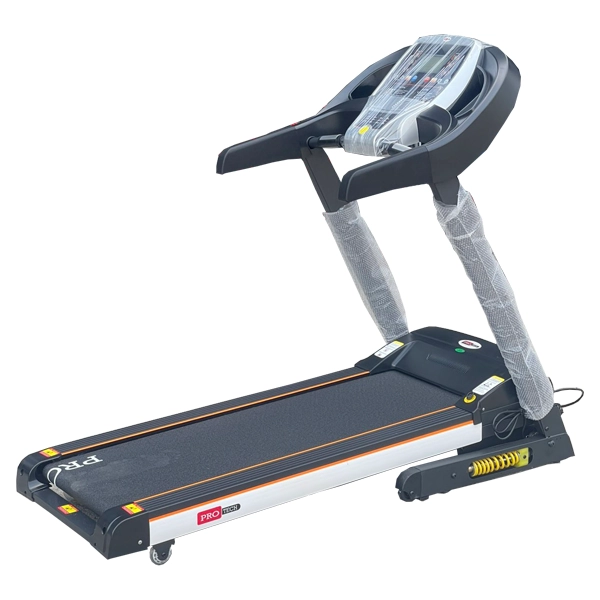
Treadmill weight capacity tells you the manufacturer's stated user limit. It does not tell you how many hours the machine can run each day, how many people may share it or whether its warranty covers a commercial gym. Those questions must be answered separately.
A family can make this mistake as easily as a business. Three people buying one machine may each fit within its weight limit while planning a combined workload the product was never intended to support.
Separate the four checks
Start with the maximum user weight for the exact model and version. Then establish the intended setting, any operating or rest limits, and the warranty conditions. A name containing “professional” or “commercial” is not a substitute for written specifications.
| Check | What it answers |
|---|---|
| Maximum user weight | Whether a user's weight falls within the stated limit |
| Intended setting | Whether the product is specified for home, shared or commercial use |
| Operating guidance | How it may be used and maintained over time |
| Warranty conditions | What support applies to the agreed use |
The Life Fitness Aspire specification sheet illustrates the practice of publishing a defined maximum user weight alongside other machine information. It does not establish the limits of another treadmill with a similar appearance or motor description.
Describe your week rather than your ambition
Tell the supplier who will use the treadmill, their approximate weights, whether sessions involve walking or running and the expected pattern. “Home use” is incomplete if the household plans several consecutive sessions every morning and evening.
For a gym, consider the busiest period as well as total opening hours. A machine may stand unused for much of the day and then receive concentrated demand. Record that expectation in the shared-facility plan.
Use estimates honestly. It is better to say that you expect three daily users and want advice on that assumption than to present a guessed workload as an established fact.
Do not invent a safety margin
People sometimes recommend adding a universal number of kilograms to a user's weight when shopping. That can create false reassurance. The important evidence is the manufacturer's rating and confirmation that the complete pattern of use is suitable.
If a user is close to a listed limit, discuss suitable alternatives with the supplier and obtain product-specific guidance. Never exceed the stated limit because another model from the same brand carries a higher rating.
Other fit checks remain necessary. The belt-size guide considers stride room, controls and the space needed during running. A suitable weight rating cannot compensate for a deck that feels restrictive.
Consider the supporting system
Workload also affects the care plan. Ask which maintenance tasks are required, how use is recorded and what signs should prompt a service enquiry. Confirm the availability of the correct wear parts for the model rather than assuming that any treadmill belt or control board will fit.
Electrical suitability deserves its own assessment. Use the backup-power checklist if a generator or inverter is involved. More advertised horsepower does not, by itself, solve capacity, durability or supply questions.
Put the agreement on the quote
For a Plus Fitness treadmill shortlist, ask the team to record the model, user limit, intended setting and proposed workload. Keep that confirmation with the order and the product-specific warranty details.
You are buying a machine for a repeated routine. A well-defined routine gives the supplier something meaningful to match, and gives you a clearer basis for deciding whether the machine suits the people who will actually use it.
Leave a Reply