
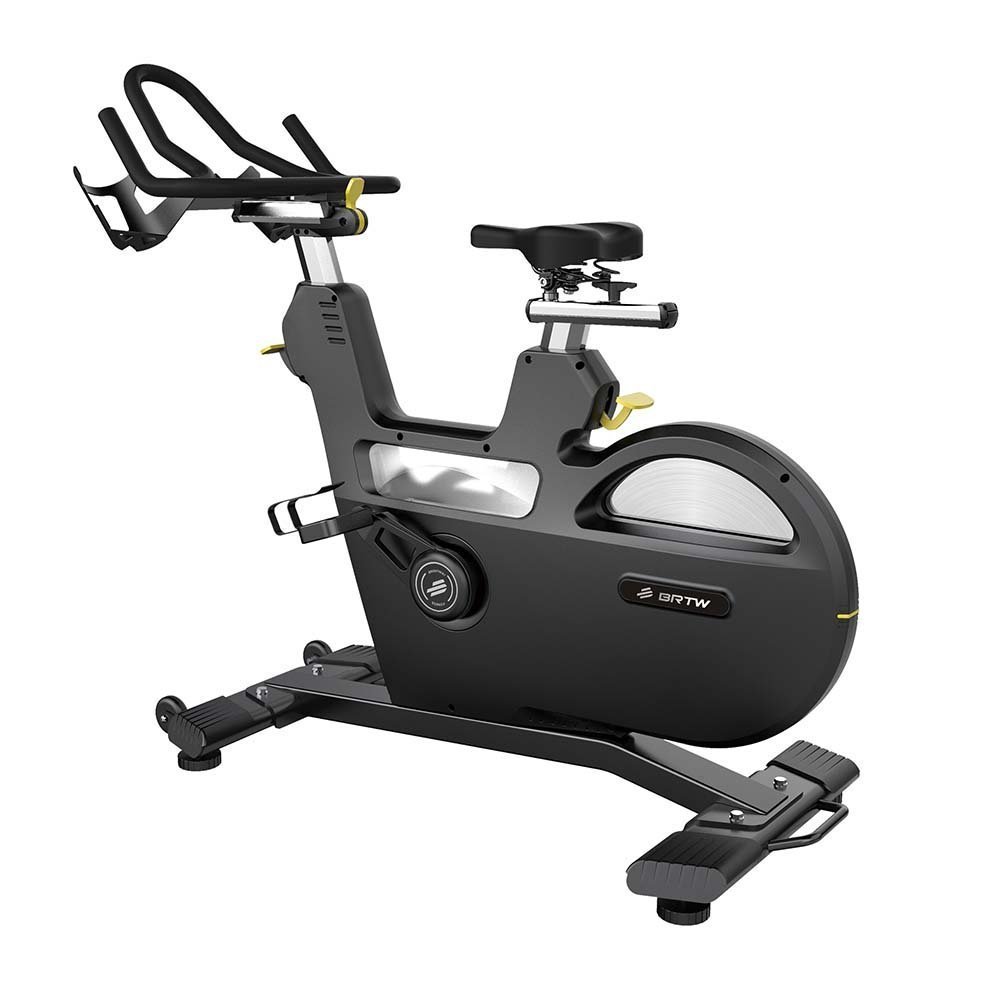
Magnetic and friction describe how an exercise bike creates braking resistance. Belt and chain describe how movement is transmitted. They are different decisions, so a belt-driven bike is not automatically magnetic and a magnetic bike is not automatically maintenance-free.
Understanding that distinction makes it easier to compare two attractive machines without letting a long feature list obscure what you are buying.
What changes the pedalling resistance
A friction system uses contact between a braking material and a rotating component. A magnetic system uses a magnetic braking arrangement. Controls can be mechanical or electronic depending on the model, and the available adjustment range varies.
Sunny's upright-bike specification, for example, explicitly describes its contactless magnetic resistance. That tells you how that product applies resistance. It does not establish the complete care requirements of every bike described as magnetic.
With a friction system, ask about the braking pad or equivalent wear component and how replacement is handled. With either system, ask about the drive, pedals, bearings, adjustment hardware and inspection schedule.
Listen to the complete bike
Magnetic braking can avoid the rubbing noise of a contact brake, but the rest of the machine still moves. A loose component, an unsuitable floor or a different drive arrangement can influence what you hear.
Try the shortlisted bike at a representative pace and resistance. Listen for the ordinary operating sound and ask the supplier to explain anything unusual. Avoid comparing noise descriptions from two unrelated marketing pages as though they were laboratory results.
If the bike will sit near a bedroom or home office, consider when it will be used. A small difference in sound may matter more in that setting than in a busy shared gym.
Examine the adjustment and stopping method
Does resistance change through a knob, buttons or a programmed console? Can you make a small useful change? Are settings numbered in a way you can repeat? A resistance level of eight on one bike is not necessarily equivalent to eight on another.
Ask how the rotating system behaves when you stop pedalling and how the model's emergency stop works, if fitted. Follow the actual manual, especially on indoor cycles with a fixed relationship between the pedals and flywheel. Do not assume that every bike allows the pedals to coast freely.
Compare ownership rather than one feature
| Buying question | Useful evidence |
|---|---|
| Does it fit? | Seat and handlebar adjustment tested by the intended users |
| Is the resistance suitable? | Demonstration across the range you expect to use |
| What needs attention? | Model-specific care schedule and wear-parts information |
| What powers the features? | Clear description of console and resistance-control requirements |
| Can it be supported? | Identifiable model and a route to parts and service |
The upright versus recumbent comparison covers seating and access. The existing exercise-bike buying guide brings those checks together with intended use and support.
Choose a system you can own comfortably
For a magnetic-bike shortlist at Plus Fitness, request the exact resistance and drive specifications. If comparing it with a friction model, ask for both maintenance schedules and test both rather than assuming the more expensive mechanism will feel better to you.
A clear service arrangement matters after purchase. Our repair-or-replace worksheet shows why knowing the model and wear components is useful later. The most suitable bike combines comfortable fit, appropriate resistance and a care routine you can realistically maintain.
Leave a Reply