
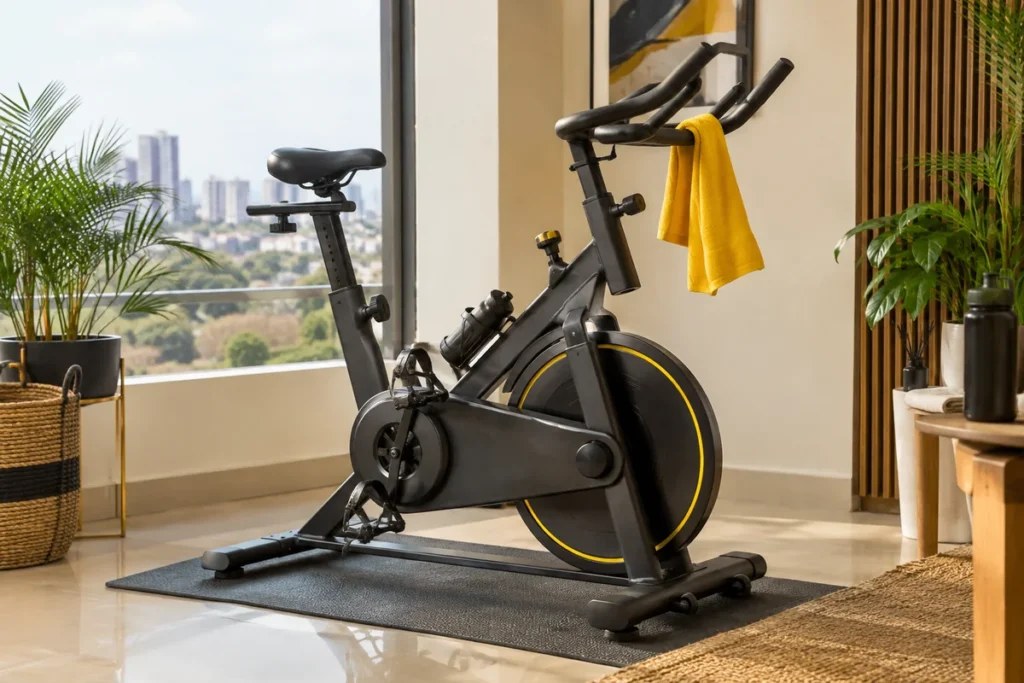
Featured image: AI-generated home-training concept; not a customer installation or an identifiable catalogue bike.
Choose an exercise bike by fit, adjustment, intended use and ownership support before comparing console features. A bike should accommodate its users, provide the resistance and controls they need, fit the room and have documentation for the proposed home or shared setting.
If a bike will serve several people, test the adjustment process as carefully as the riding position. A machine that fits one buyer well may be inconvenient for the next user to set up.
Start with the type of bike and the intended activity
Upright, recumbent and indoor-cycle-style bikes place the user in different positions and use different adjustment arrangements. Decide what kind of activity the users intend, then assess suitable models rather than treating all exercise bikes as interchangeable.
A recumbent design may offer a different access and support arrangement, but it is not automatically the correct choice for a health condition. If a medical issue affects equipment use, seek advice from an appropriate healthcare professional. The retailer can explain product features; that is separate from determining clinical suitability.
For a home buyer, consider who else will use the bike and where it will remain between sessions. For a shared facility, record likely use, supervision and how users will obtain help with adjustments.
Check fit with a real adjustment demonstration
Ask about the available seat and handlebar adjustments, the access route onto the bike and the manufacturer’s user limits. Where possible, try the exact model with guidance on correct setup. Do not select solely from an advertised user-height range if the adjustments have not been demonstrated.
Look at the controls as well. Can users reach them in the intended position? Are the markings readable? Can the seat and other adjustable parts be secured and checked without guesswork?
For shared use, time spent readjusting is part of the experience. A clear, repeatable setting system can be useful when people change frequently. Record individual preferences privately where appropriate; avoid displaying personal health information on a shared machine.
Understand resistance descriptions
Bike listings may describe magnetic, friction or air resistance, among other design features. These labels indicate aspects of how the machine creates resistance, but they do not by themselves establish ride quality, noise, maintenance needs or suitability for commercial use.
Ask how resistance is adjusted and what happens when the user stops pedalling. Some indoor cycles have different flywheel and stopping arrangements from other exercise bikes. The manual and a demonstration should explain the exact model’s behaviour and controls.
Do not compare the number of resistance levels as if it were a universal scale. Level 10 on one bike does not necessarily match level 10 on another. Compare whether the range and adjustment process suit the intended users, supported by the manufacturer’s information.
Compare the features that affect daily use
| Feature | Useful buying question |
|---|---|
| Adjustment range | Can each intended user achieve an appropriate setup? |
| Entry and exit | Is access suitable for the users and room? |
| Resistance controls | Are they understandable and usable during the activity? |
| Pedals and retention system | What footwear and manufacturer-approved setup are required? |
| Console | Which functions work independently, and which need an app or subscription? |
| Power | Does the model require mains power, batteries or another arrangement? |
| Moving and storage | How is the bike moved, and where can it be stored as instructed? |
If connectivity is a selling point, check the current app compatibility, supported devices and any recurring charges with the manufacturer before purchase. Features can change; a console photograph does not prove that a service remains available in your location.
Plan the room and power supply
Measure the installed bike and allow the clearances specified by its manufacturer, including access for adjustment and maintenance. Check the delivery route and the surface on which it will stand. A compact footprint does not eliminate the need for usable space around it.
Confirm the electrical requirements for the exact model. Some functions may use mains power even if the exercise mechanism seems simple. Have a qualified electrician assess the proposed supply or backup arrangement where needed; do not infer compatibility from a different appliance in the room.
If noise matters, request a demonstration in conditions that help you judge the actual machine, while recognising that the final room can sound different. Avoid relying on “silent” as an absolute product claim. Flooring, assembly, maintenance and the building itself can affect what occupants notice.
Describe exposure to moisture, dust and outdoor conditions accurately. An indoor bike should not be placed in a partly open area without confirming the manufacturer’s permitted environment.
Home and shared use need explicit confirmation
Ask for the intended use classification and warranty coverage in writing. A household bike used occasionally by one person and a machine used repeatedly in a hotel are different purchasing situations. Do not assume the word “commercial” in a title answers all operating and warranty questions. The shared-gym planning guide helps define who will use the bike and who will look after it. Record ownership tasks in a maintenance log. If a faulty treadmill prompted the purchase, use the fault-recording checklist before deciding whether to repair or replace it.
The Commercial Magnetic Exercise Bike is a current Plus Fitness catalogue example. Request the exact model documentation, adjustment range, user limits, power requirements and support conditions before deciding whether it fits your facility.
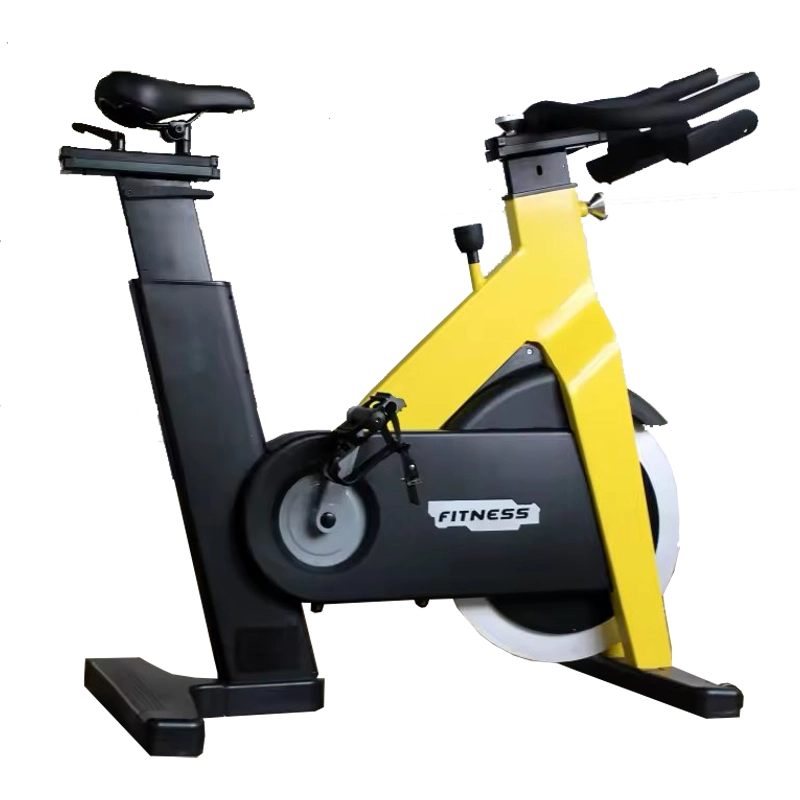
Compare it with other options in the cardio equipment category. The aim is a documented fit for your requirements, not a universal recommendation of one model.
Ask how the bike will be maintained
Obtain the cleaning and maintenance instructions and identify which tasks the owner can perform. Do not apply oil, tighten components to guessed values or open covers based on advice for another bike. Similar-looking machines can have different requirements.
Manufacturer resources such as Concept2’s BikeErg maintenance page show the importance of model-specific instructions. That page applies to the BikeErg; it should not be used as a service schedule for an unrelated exercise bike.
Ask about replacement pedals, straps, adjustment components and other parts relevant to the model. Establish the support contact and what information is needed when reporting a fault. Retain the invoice, model and serial number together with the manual.
For shared facilities, assign someone to record faults and prevent use until an appropriate person has resolved any safety-related issue. The existing maintenance guide can help organise those responsibilities.
Compare the complete purchase
Include delivery to the intended room, assembly, any required accessories and product-specific support. Ask whether staff or household users will receive a demonstration of adjustments and stopping controls. Confirm what you must prepare before the delivery arrives.
Read the warranty and returns policy and obtain the terms for the exact bike and proposed use. Do not assume every component has the same coverage or that transport and labour are automatically included.
If you are still choosing a cardio format, the existing treadmill versus elliptical guide offers another comparison. If cycling is already the right direction, contact Plus Fitness with your room dimensions and intended users to arrange a model-specific discussion or demonstration where available.
Prepared with AI assistance. Sources and product links checked on 18 September 2026.
Leave a Reply