
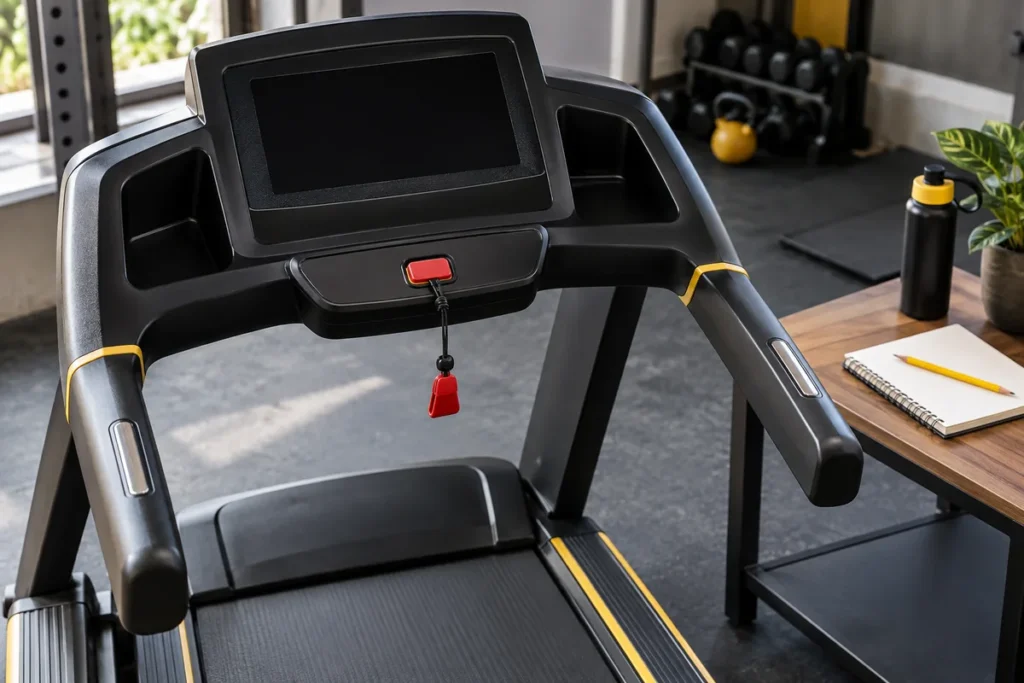
Featured image: AI-generated fault-reporting illustration; the console does not show a real model or diagnostic code.
If a treadmill stops unexpectedly, slips or displays an error, stop using it and record what happened before contacting support. The most useful first step is a clear fault report with the exact model, error message and circumstances. Guessing at belt adjustments or opening covers can make the problem harder to diagnose and may expose you to additional hazards.
This guide helps an owner or facility manager prepare for service. It is not a repair procedure. Use the manual for the exact treadmill, and have electrical or mechanical work carried out by people competent for the task.
First, keep the fault from reaching the next user
Stop the session using the equipment’s controls as instructed. If there is smoke, a burning smell, exposed wiring, visible damage or another immediate hazard, keep people away and seek appropriate assistance. Do not touch suspect electrical parts or repeatedly restart the machine to see whether the problem disappears.
In a shared facility, mark the treadmill out of use and tell the person responsible for equipment. A fault recorded only in a private message can be missed by the next shift. Follow the site’s safe isolation arrangements and the manufacturer’s instructions; do not improvise electrical work.
HSE’s maintenance guidance emphasises competent work and safe arrangements for maintenance. This general reference is not a model-specific service instruction or a statement of Nigerian legal requirements.
Identify the machine accurately
Find the make, model and serial number in the documentation or on an accessible identification label. Do not remove a cover or move a heavy machine solely to reach a label. If the label is inaccessible, tell the service contact what information you have.
Keep the purchase date, supplier, installation record and warranty documents nearby. If the treadmill was moved recently, record when and by whom. If service has already been carried out, include the previous job reference rather than asking the next technician to start without that history.
A product name such as “3 HP treadmill” is not enough to identify every component or fault code. The exact model and version matter.
Copy the error exactly
Photograph or write down the complete message, including letters, numbers and any sequence in which they appear. Record whether it appeared at startup, during a session, during an adjustment or after stopping.
Do not assume a code means the same thing on another brand or model. Online explanations may describe a different controller or software version. Send the code to the supplier or manufacturer with the model details and ask for the appropriate next step.
If the display went blank, say that. Avoid translating an observation into a diagnosis such as “the motherboard failed” unless a competent technician has established it. Clear observations are more useful than confident guesses.
Describe what happened without deliberately recreating it
Record the activity immediately before the fault, the approximate elapsed time and the controls in use. Note any unusual sound, smell or change in movement that was already observed. Do not keep exercising on a slipping or stopping belt to obtain a better video.
If a safe photograph can be taken while the machine is out of use, it may help identify visible damage or the display message. Do not film someone running on a faulty treadmill as a demonstration.
| Observation | Useful detail |
|---|---|
| Unexpected stop | When it occurred and what the display showed |
| Slipping or uneven movement | What the user noticed, without attempting further loaded tests |
| Error code | Exact characters and when they appeared |
| Unusual sound | Location and description, if already observed safely |
| Power-related event | Whether the room supply or a protective device also changed |
| Recent change | Relocation, service, cleaning, power arrangement or other relevant event |
The table is a reporting aid, not a fault-code decoder. Several different causes can produce a similar symptom.
Record the power context, but do not investigate live electrics
Tell support whether the machine was connected to its usual supply and whether anything changed recently. If a protective device tripped, record that fact. Do not repeatedly reset it, replace it with a higher-rated device or bypass protection.
A qualified electrician should assess supply concerns against the treadmill’s requirements. Do not assume a generator, inverter, extension lead or adaptor is suitable because the machine powers on. Starting successfully does not establish that the full installation is correct.
Use the manual intended for the exact model and region. Manufacturer document libraries, such as Woodway’s manual library, can distinguish regional documentation. A North American electrical specification should not be applied to a Nigerian installation without confirming the correct equipment version.
Avoid generic belt and lubrication advice
Belt tension, alignment and lubrication requirements vary. Some procedures involve specific measurements, materials or operating conditions. Do not apply a fixed number of bolt turns, a universal lubricant or a service interval copied from another treadmill.
Tell the technician what maintenance was last performed and which product was used, if known. If the history is unknown, say so. Do not add lubricant immediately before a service visit to make the machine appear maintained.
Do not remove guards, bypass a safety key or change internal settings to clear an error. Ask support which owner checks, if any, are appropriate for the identified model. Keep any written instructions with the fault record.
Send one complete service enquiry
A concise report reduces avoidable back-and-forth. Include the location, model and serial details, purchase reference, exact symptom or code, when it occurred, relevant recent changes and safe photographs. State that the treadmill is out of use where that is the case.
For example: “Treadmill asset TM-02 stopped during use and displayed the attached code. It has been taken out of service. Model and serial details, purchase reference and the previous service date are attached. Please advise the next checks and service arrangements.” This is an illustrative message, not a real customer incident.
Ask whether the proposed visit is covered by the product’s warranty, and request the basis of any call-out, travel, labour or parts charge. The Plus Fitness warranty and returns policy provides general information; coverage for a particular fault must be assessed against the relevant terms.
Close the fault properly
After service, retain the diagnosis, work performed, parts replaced and any restrictions or follow-up requirements. Record who confirmed the treadmill could return to use. Do not remove an out-of-use notice merely because the display now turns on. Keep the service outcome in the equipment maintenance log alongside the original handover information. If replacement becomes the informed decision, the exercise-bike buying guide explains a different cardio option without assuming it suits every user.
For a shared gym, pass the outcome to staff and update the equipment record. A recurring symptom should be linked to earlier reports so the service provider can see the pattern.
For ongoing care, see the equipment maintenance guide. To request help, contact Plus Fitness with the complete fault report and ask about support for the exact machine and location.
Prepared with AI assistance. Sources and product links checked on 18 September 2026.
Pingback: A Nigerian's Guide to Buying a Treadmill: Prices, Power & Best Models for 2026 - Sports & Fitness Shop in Port Harcourt | Plus Fitness