
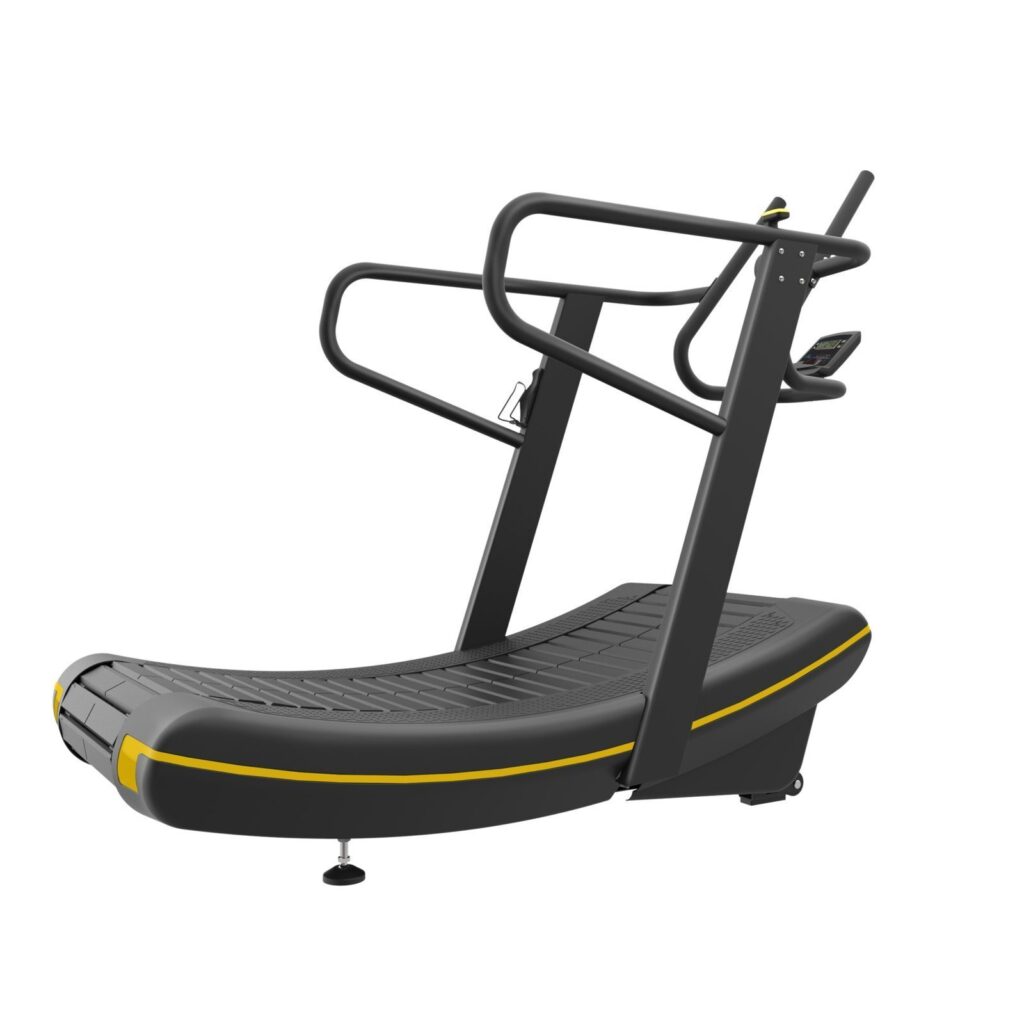
A curved manual treadmill moves under the user's effort, while a motorised treadmill drives the belt at a selected speed. That difference changes pace control, the feel of a session and the ownership requirements. A curved machine can remove the need to power a drive motor, but it does not automatically become the best option for every home or gym.
The decision becomes clearer when you compare the session you want, rather than treating “manual” as a cheaper version of “motorised”.
Who sets the pace
On a motorised treadmill, the user normally selects a belt speed through the controls. On a curved self-powered design, the user contributes the effort that moves the belt and learns how the machine responds to their position and pace. Follow the model's familiarisation instructions rather than copying a technique from a different curved machine.
The Woodway Curve owner manual is an example of manufacturer-specific operating guidance. Its instructions concern that machine and should not be substituted for the manual supplied with another model.
If you prefer a set pace that remains stable during a session, motorised control may suit you. If you value self-paced changes, a suitable curved design may be appealing. Test both under supervision where possible. An unfamiliar movement can feel awkward before you have enough experience to judge it fairly.
Compare more than electricity
| Consideration | Curved manual design | Motorised design |
|---|---|---|
| Belt drive | User-powered | Motor-powered |
| Pace adjustment | Through user effort and the model's operating method | Through speed controls |
| Electrical planning | Check any console requirements separately | Check the full installation requirements |
| Maintenance | Still requires model-specific care | Requires model-specific mechanical and electrical care |
The absence of a drive motor does not mean that every component is maintenance-free. Belts or slats, bearings, frame hardware and consoles still need the care specified for the exact product. Ask about the parts that are likely to require attention and who can assess a problem locally.
Our electricity-cost article can help you estimate powered running costs. Compare that figure with purchase price, servicing, space and likely use. Do not assume a lower electricity bill will recover a larger purchase price within a particular period without doing the calculation.
Fit the users and the setting
A commercial gym may want a self-paced machine for a particular training area. A household may want straightforward walking with familiar speed controls. Those are different requirements, and neither describes all users in that setting.
Check the entry and exit procedure, accessible handholds, control layout and permitted user capacity. For shared use, confirm the intended operating setting and warranty. The weight-capacity guide explains why a maximum user figure is not a statement of unlimited daily use.
Avoid buying on a headline claim that a machine burns a fixed percentage more calories. Such comparisons depend on the equipment, people and test conditions. They do not tell you how often you will use the machine or whether it fits your training plan.
Try the experience before ordering
Ask for a demonstration of starting, changing pace and stopping. Then consider how the machine will be introduced to other household members or gym users. Clear instruction is particularly useful when someone expects a self-powered belt to behave like the motorised machine they already know.
If cycling is also an option, the existing exercise-bike buying guide offers another way to compare fit and intended use. For a curved shortlist, review the Plus Fitness Curve Treadmill and request its exact operating manual and support details. Buy for the experience and setting you need, with energy use included as one part of the decision.
Leave a Reply