
Choose a rowing machine by the feel of the stroke, fit, working space and maintenance arrangements before deciding between air, water and magnetic resistance. The resistance label helps explain the mechanism, but it cannot tell you everything about noise, build quality or long-term support.
A rower can look compact when nobody is using it. During a stroke, the seat travels, the handle moves and the user needs room. Buying from a photograph without understanding that movement is an easy way to underestimate the space required.
Understand what each system contributes
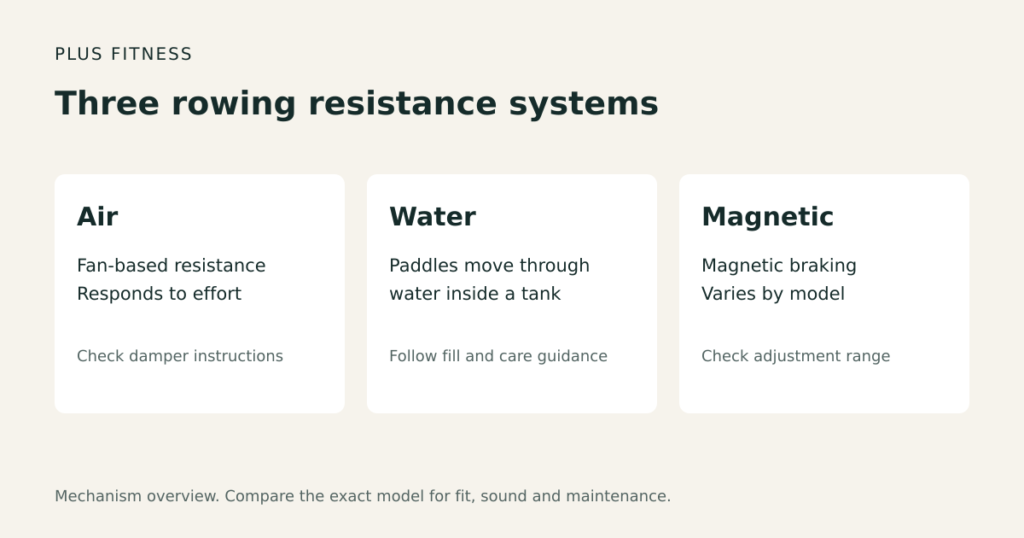
An air rower uses a fan-based resistance system. On a water rower, paddles move through water in a tank. A magnetic rower uses a magnetic braking arrangement, with the exact adjustment and control system depending on the model. Some products combine mechanisms.
For its own equipment, Concept2 explains that effort affects resistance and that the damper setting changes the feel rather than acting as a simple difficulty scale. This is useful background when trying an air rower. It is not a reason to assume every machine's numbered lever behaves identically.
The WaterRower manual similarly distinguishes rowing effort from tank fill level. Follow that model's filling instructions; do not treat adding water as a universal resistance adjustment for every tank-based rower.
Compare the whole experience
| Feature to compare | What to test or request |
|---|---|
| Stroke feel | Smooth movement through your normal stroke and an appropriate resistance range |
| Fit | Seat travel, foot adjustment, handle reach and permitted user limits |
| Sound | A demonstration at the effort and location relevant to you |
| Console | Useful metrics, units, connectivity and functions available offline |
| Care | The exact maintenance schedule and consumables |
| Storage | Approved positioning and safe handling procedure |
Avoid an absolute promise that one resistance type is silent. The mechanism, drive, seat rollers, floor and user all contribute to what you hear. A quiet demonstration in a large showroom also says little about vibration in an upstairs flat.
If possible, hear the shortlisted model while someone rows at a representative effort. For a home, consider whether the sound would interrupt nearby work or sleep. For a gym, consider whether several machines will operate at once.
Fit starts at the feet and seat
Ask for the manufacturer's user-size information and check the adjustment range. A suitable seat position should allow the user to follow the correct rowing sequence without running out of rail travel or reaching awkwardly for the handle. A coach can help distinguish unfamiliar technique from a genuine equipment-fit problem.
Test getting on and off as well as rowing. A low seat may be convenient for storage yet awkward for a particular user. Neither age nor fitness level alone tells you which seat height is suitable.
If you are comparing different seated cardio options, use the upright and recumbent bike guide alongside the existing exercise-bike buying guide. The right movement is the one that fits the user and intended routine, not whichever machine receives the strongest full-body marketing claim.
Treat maintenance as part of the purchase
Request the maintenance instructions before ordering. Establish whether the drive uses a chain or belt, how the rail and rollers are cared for, and which inspections the owner should perform. A water tank may have specific treatment instructions. A magnetic brake does not remove the need to inspect other moving parts.
Ask what happens if a strap, roller, sensor or console requires replacement. A retailer saying “parts are available” is more useful when it is tied to a named model and a clear enquiry process.
In humid rooms, choose an appropriate location and follow the permitted care methods. Our rust and humidity article explains why moisture and cleaning residues deserve attention without turning every metal mark into a repair diagnosis.
Decide which numbers you will use
Some people want only time and a consistent way to track sessions. Others need a particular data platform or comparable performance metrics. Confirm compatibility before paying for connectivity you may not use.
Do not compare calorie or distance readings across different brands as though they were interchangeable measurements. The console-readings guide explains how to build a more useful record.
Ask Plus Fitness to confirm any current cardio-rower options and provide the exact resistance system, working dimensions, user limits and maintenance documentation. A strength machine labelled as a row does not serve the same purpose as a cardio rower. A short demonstration, a room measurement and a clear support conversation will usually answer more than a long list of generic features.
Leave a Reply