
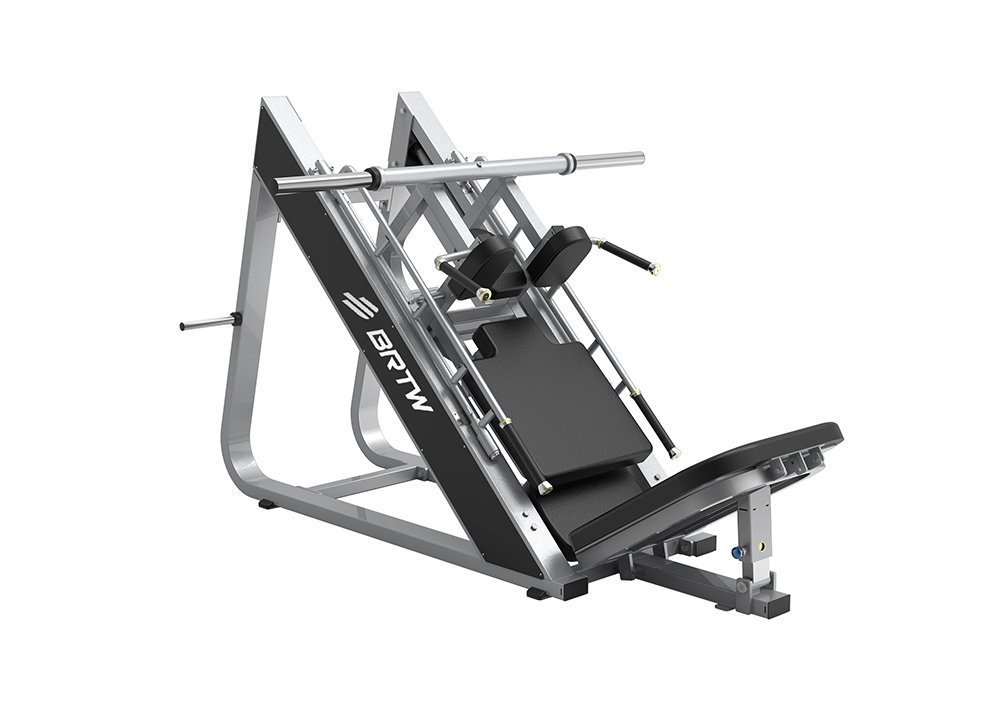
A leg press and a hack squat can both provide guided lower-body resistance, but they position the user differently. Choose by checking how the exact machine fits the intended users, how its movement and stops operate, and how much working space it needs. A combined machine is useful only if both configurations are practical to set up and use.
The number of exercise modes in the description matters less than whether staff and users can change between those modes correctly.
Understand the arrangement you are comparing
On many leg presses, the user pushes against a platform while supported by a seat or back pad. A hack-squat design commonly supports the user under pads while a carriage moves along guides. There are different layouts within both categories, so photographs and category names are only the start of the comparison.
Ask for a demonstration of entry, starting position, release controls, range-setting features where provided and the finish position. A competent coach can help assess whether the movement and adjustment options suit the people who will use it.
Do not assume a guided machine makes every load or movement appropriate. The product's instructions and the user's programme still matter.
Test the conversion on a combination machine
Watch the full change from leg press to hack squat and back again. Record which pads, platforms or supports move and how they lock. Check whether any parts are removed and where they are stored.
A conversion that is manageable in a quiet showroom may be less convenient when several people are waiting. If staff must perform the change, plan for that rather than expecting every user to understand the mechanism.
Manufacturer resources such as the Body-Solid manual library show why the precise model matters for assembly and operation. Instructions for a similar-looking combination machine are not interchangeable.
Compare usable capacity and the room
| Item to establish | Practical reason |
|---|---|
| Starting resistance | The carriage may create resistance before plates are added |
| Permitted load | Product limits apply to the exact configuration |
| Plate compatibility | Sleeve size and available loading length must match the plates |
| Adjustment range | Different users need an appropriate starting setup |
| Loading access | Someone needs room beside the machine to handle plates |
Keep plate storage and the approach route on the drawing. A large machine can fit its allocated rectangle while leaving no comfortable way to load it.
The plate comparison explains why plate thickness and construction affect a complete setup. For broader loading arrangements, read the existing pin-loaded versus plate-loaded guide.
Think about a busy hour
A combination machine typically provides alternative uses of one physical station. Do not count it as two independent stations simply because it has two names. The multi-station planning article explains how to assess actual simultaneous use.
For a small private room, switching modes may be a sensible space-saving compromise. For a busy gym with persistent queues, separate stations may be more useful if space, budget and demand justify them.
Ask for a complete demonstration
Plus Fitness lists a leg-press and hack-squat combination. Request the exact model's manual, starting resistance, load limits, adjustment details and operating footprint. Bring the user requirements rather than asking which machine is universally better.
The right decision is the one whose fit, conversion process and capacity make sense in your facility. A versatile machine earns its place when its extra function is genuinely usable.
Leave a Reply