
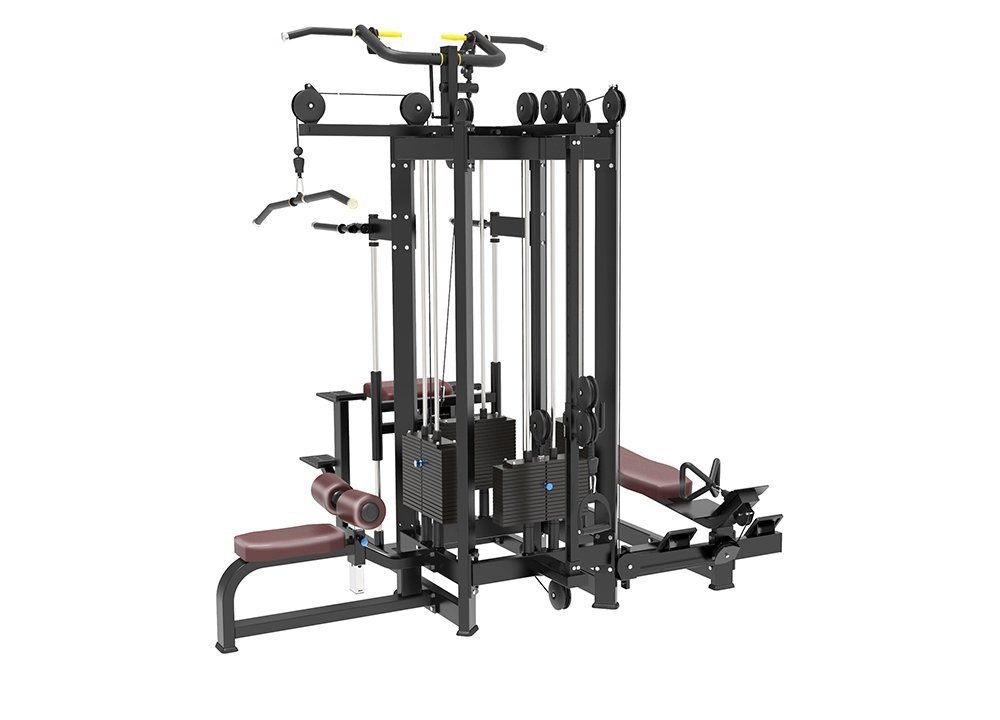
The number of exercise stations on a multi-station gym is not necessarily the number of people who can train on it at once. Shared weight stacks, crossing cables, overlapping movement areas and access requirements can reduce practical simultaneous use. Ask for the manufacturer's permitted combinations and map the users' positions.
A machine with four exercise names may provide four choices for one user, several independent stations, or a combination of both. Those are different purchases.
Identify independent resistance and shared components
Start with the weight sources. Does each station have an independent stack or loading system? Does changing one setting affect another outlet? Are there functions that the manufacturer expressly prohibits using together?
Then examine the physical movement. Independent resistance does not solve a conflict where two users need the same floor space, bench or approach route. A moving handle should not pass through another person's working area.
Use the exact manual and a supplier demonstration. A manufacturer's model-specific documentation is the appropriate place to establish the arrangement; counting visible handles is not.
Draw people into the layout
Mark where each user stands or sits, where they enter and leave, and where equipment moves. Include any bench, attachments and plate-loading positions. Keep required circulation and emergency routes available.
An illustrative three-station layout might allow two people to train together comfortably while a third exercise requires space already occupied by one of them. That is a planning example, not a claim about a particular product. The only way to resolve it is to check the actual geometry and approved use.
The shared-gym planning guide helps connect equipment choices with expected demand. A hotel with intermittent individual use may value a different arrangement from a studio coaching several people in one session.
Build a simple combination table
| Combination | Manufacturer permits it | Working areas clear | Practical result |
|---|---|---|---|
| Station A and station B | Check | Check | Record after assessment |
| Station A and station C | Check | Check | Record after assessment |
| Station B and station C | Check | Check | Record after assessment |
The letters are placeholders for the real stations. This table prevents the sales description from becoming an untested capacity assumption.
For cable-based systems, read the functional-trainer checklist. Stack independence and pulley ratios both matter, but they answer different questions: who can use the system and what resistance each outlet provides.
Allow for adjustment time
Even where simultaneous use is permitted, users may need to change seats, handles or settings between exercises. If one attachment serves several stations, it can create a queue of its own.
Observe how long an ordinary change takes during the demonstration. Consider whether instructions are clear enough for independent users or whether staff will assist. Avoid basing capacity on the fastest setup by someone who knows the machine intimately.
Buy against the busiest real use
For an existing gym, record demand before adding another machine. The gym-expansion article explains how to distinguish a genuine equipment shortage from a timetable or layout problem.
Plus Fitness lists a four-station multi-jungle machine. Ask which station combinations are approved for simultaneous use and request a layout showing their working areas. A smaller, clearly usable arrangement can be more valuable than a larger station count that creates conflicts at the time you need it most.
Pingback: Gym Expansion Equipment What to Buy Next