
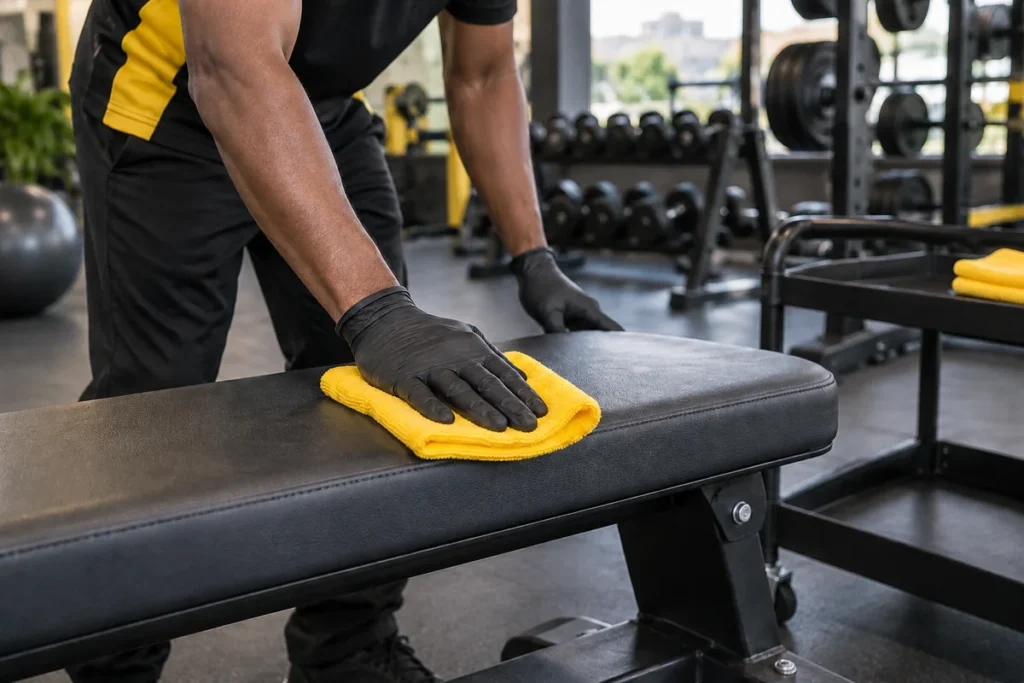
Featured image: AI-generated cleaning illustration; always follow the actual equipment and cleaning-product instructions.
A workable gym cleaning routine matches the surface, the equipment manufacturer’s instructions and the cleaning product’s label. Staff need to know what to use, how to apply it, how long any disinfectant must remain in contact and when the equipment can return to use. A bottle placed beside a machine is not a complete procedure.
For a shared facility, separate user wipe-down arrangements from staff cleaning, fault checks and any incident-specific response. This guide focuses on organising that routine without prescribing a universal chemical mixture.
Cleaning and disinfecting are different tasks
Cleaning removes dirt and other material. Disinfection uses an appropriate product according to its label to address specified microorganisms. A quick wipe does not prove that a disinfectant has been used correctly or that the required contact time has been met.
The CDC’s guidance for athletic facilities advises cleaning shared equipment after use, allowing it to dry and following both equipment instructions and cleaning-product directions. Its guidance is useful for shared sports environments; it is not a product approval list for Nigeria.
Decide what the routine requires with the relevant facility lead and product guidance. If an incident, outbreak or bodily-fluid contamination requires a special response, follow the appropriate professional or public-health advice rather than extending an ordinary wipe-down routine by guesswork.
Make a surface register
Different parts of one machine may need different treatment. Upholstery, painted frames, rubber grips, touchscreens and exposed moving components should not automatically receive the same product or application method.
Record the approved cleaning instructions for the equipment you own. Ask the supplier or manufacturer when compatibility is unclear. Do not test a strong chemical on a visible surface simply because it worked on a different machine.
| Surface or item | What the routine should specify |
|---|---|
| Upholstery and pads | Compatible product, application method and drying instructions |
| Handles and grips | Approved cleaning method and access to all contact surfaces |
| Consoles and controls | Manufacturer-approved method that protects the equipment |
| Mats and flooring | Product-specific cleaning, drying and storage requirements |
| Shared accessories | How items are collected, cleaned, dried and returned |
Keep the register practical. Staff should be able to find the relevant instruction without searching several manuals during every cleaning round.
Write the task in the order staff perform it
For each task, state the item, preparation, product, method, any required contact time, drying or reopening condition and the person responsible. Use the label and equipment instructions to fill in those details; do not invent a single contact time for all products.
Where the equipment instructions require shutdown or isolation before cleaning, include that step and the authorised process. Staff should not spray or wipe moving equipment while someone is exercising on it.
Keep chemicals away from electrical openings and components as directed by the manufacturer. Follow instructions on ventilation and protective equipment. Do not mix cleaning products or use an unlabelled decanted liquid whose contents cannot be established.
Organise supplies so the routine is easy to follow
Provide the correct materials where staff need them, with clear identification and suitable storage. Keep cleaning chemicals secured from unauthorised access and separate from drinks or personal-care products. Retain labels and safety information in a place responsible staff can access.
Decide how cloths are collected, cleaned or replaced according to the chosen system. A colour-coding arrangement can be useful if it is simple and taught consistently, but colours themselves do not establish hygiene. The process behind them matters.
Keep a small stock record for consumables. Running out of the approved product should trigger replenishment, not an improvised substitution. If a substitute is proposed, check compatibility and update the instructions before staff use it.
Set expectations for users without handing over staff responsibility
If users are asked to wipe equipment, make the instruction short and specific to the approved arrangement. Explain where used materials go and how to report a spill or a problem. Avoid a sign that says only “sanitise after use” if the actual method is unclear.
Staff still need an assigned routine for shared spaces, accessories and areas users may miss. Do not treat a user’s wipe-down as a technical inspection or as evidence that every surface has been disinfected correctly.
In a hotel or office, consider whether first-time users can understand the arrangement without assistance. Place instructions where they are useful without covering machine warnings or controls.
Use cleaning as an opportunity to report defects
Staff may notice torn upholstery, damaged grips, loose parts or liquid near electrical equipment while cleaning. Give them a clear reporting route and authority to stop the cleaning task when something appears unsafe. They should report observations, not attempt a repair outside their competence. Move equipment defects into the maintenance log rather than leaving them only on a cleaning sheet. Agree responsibilities within the shared-gym operating plan; schools can apply the same ownership approach when planning their sports kit.
Keep fault reporting separate from the cleaning tick box. “Cleaned” should not conceal “seat pad torn” or “console cover damaged”. In a shared facility, the equipment status must be clear to the next shift and to users.
The existing maintenance guide provides broader ownership context. Cleaning records and maintenance records should support each other while remaining distinct.
Keep records proportionate
A short record can identify the area, task, time, responsible person and any exception. Record missed tasks and the action taken rather than filling every box retrospectively. The purpose is a usable operating record, not paperwork that gives a false impression of certainty.
Review the routine when equipment, products, staffing or use changes. A new touchscreen, different upholstery or a new disinfectant may require revised instructions. Keep obsolete instructions out of the active cleaning station so staff do not follow two conflicting versions.
Do not make a marketing claim that the gym is “germ-free” because a routine exists. State what the facility does accurately and keep claims proportionate to the evidence.
Before buying equipment for a shared space
Ask about cleaning requirements alongside dimensions and capacity. Confirm which materials and products are compatible, how surfaces are accessed and whether replacement upholstery or grips can be obtained. Maintenance and cleaning effort are part of ownership, not minor details to discover later.
Contact Plus Fitness about care instructions for the equipment you are considering. Provide the exact model or product link and describe the shared setting so the team can direct you to the relevant documentation and support.
Prepared with AI assistance. Sources and product links checked on 18 September 2026.
Leave a Reply