
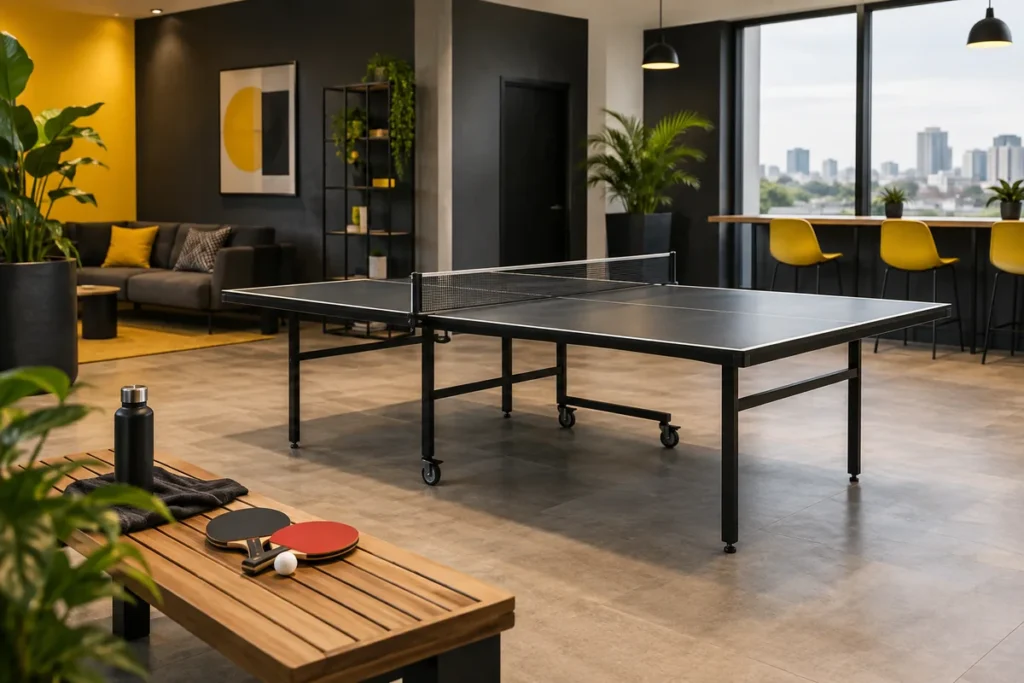
Featured image: AI-generated recreation-room concept; not a completed Plus Fitness project or a measured room layout.
A table-tennis purchase starts with the room, not just the table. Check the space for play, the delivery route, the storage position and the people who will move or unfold it. Then compare the table’s intended environment, locking arrangements, surface, net and accessories.
For a home or office, a full-size table may fit inside the room while leaving too little useful space around it. A measured layout and a realistic demonstration of movement are more valuable than a photograph that makes a small room look spacious.
Know the table dimensions—and what they exclude
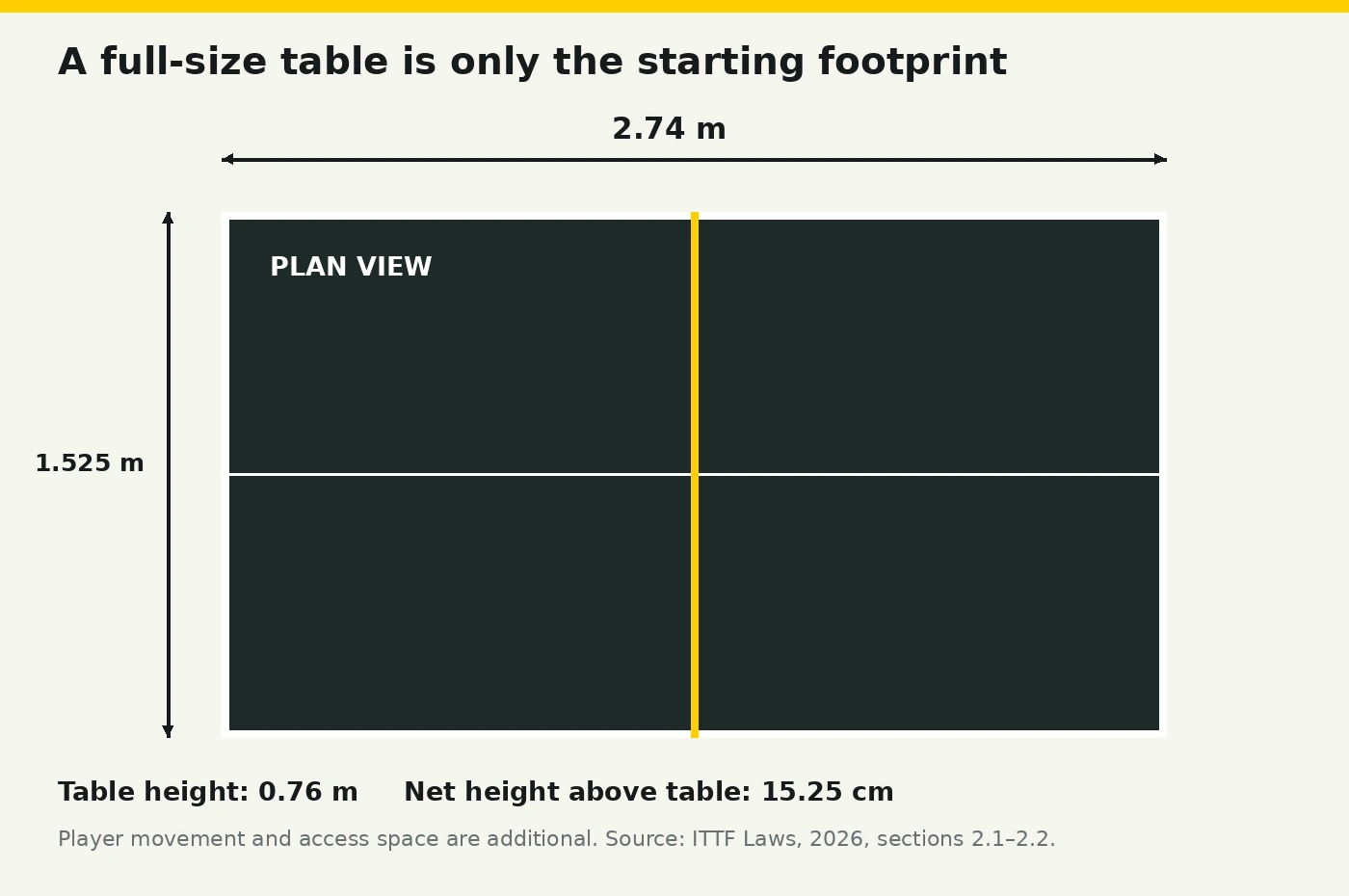
Under the ITTF’s 2026 Laws of Table Tennis, the playing surface is 2.74 m long, 1.525 m wide and 0.76 m above the floor. The top of the net is 15.25 cm above the playing surface. These are table and net dimensions, not the total room size needed for play.
Additional space is needed for players, movement, access and the particular use. Competition requirements and informal home use are different contexts. Do not apply a single internet “minimum room size” without understanding the activity, players and relevant rules.
Use the dimensions to mark the table footprint on a measured plan.
Then consider the space around it with the intended users and, where appropriate, a coach or organiser. Include doors, furniture and routes that other people need to use.
Map three states of the room
The room has an in-use state, a folded or stored state where applicable, and a movement route between them. Check all three. A table that stores neatly against a wall may still be difficult to unfold without moving other furniture.
Record the dimensions of the exact model when assembled, folded and packaged. Folding arrangements vary: some tables separate into halves, while others use a different frame and storage system. Do not assume the photograph shows every moving component or required clearance.
| State | What to measure or confirm |
|---|---|
| Playing | Table footprint, player movement, doors and circulation |
| Moving | Wheels, thresholds, turns and the route to storage |
| Stored | Folded dimensions, approved position and locking arrangements |
| Delivered | Package dimensions, weight, stairs, lift and assembly scope |
For an office, include the person responsible for facilities in the plan. A recreation area should not depend on blocking a fire exit, meeting-room door or shared walkway.
Choose indoor or outdoor use from the specification
An indoor table should not be treated as weather-resistant because it is placed under a veranda. Describe exposure to humidity, rain, sun and dust, and ask for the manufacturer’s permitted environment for the exact product.
If an outdoor table is proposed, confirm what that claim covers and how it should be stored or protected. A cover does not automatically convert an indoor product into an outdoor one. Follow the table maker’s care and storage instructions.
Consider lighting and glare as part of the room review. A bright window directly behind one end can affect how the space feels to players. Assess the actual room at the times it will be used rather than relying only on a supplier’s showroom demonstration.
Compare stability, adjustment and folding controls
Ask the supplier to demonstrate the table’s levelling, wheel brakes and folding or locking arrangements where fitted. Identify who is authorised to move it and whether the manufacturer specifies a particular handling process or number of people.
Keep children and other bystanders away from moving or folding parts during the demonstration and normal setup. Follow the instructions for pinch points and locking. Do not let an unfamiliar user experiment with a folded table to discover how it opens.
For a shared office or school, understandable controls and a clear storage procedure are useful buying criteria. A table that only one employee knows how to move can become a practical problem when that person is away.
Read the specification beyond tabletop thickness
Top thickness is one detail, not a complete quality assessment. Ask about the material, frame, intended use, surface care, levelling and the complete model’s construction. Do not rank different materials solely by one thickness number.
If a consistent playing experience matters, request an appropriate demonstration or the manufacturer’s performance information. Avoid claiming competition suitability unless the exact model and approval requirements have been verified.
A compact table can be useful where space is limited, but label it accurately. It should not be described as regulation size if it does not meet the relevant dimensions. The trade-off may be sensible for recreation as long as the buyer understands it.
Include the net and small accessories
Confirm whether the net and post assembly are included and compatible with the table. Check how they attach, how tension or height is set where adjustable and whether they must be removed before folding.
List the rackets, balls and storage needed for the expected users. Buying a table without enough usable accessories can make the first session unnecessarily difficult. At the same time, a large mixed bundle may be less useful than a small consistent set suited to the activity.
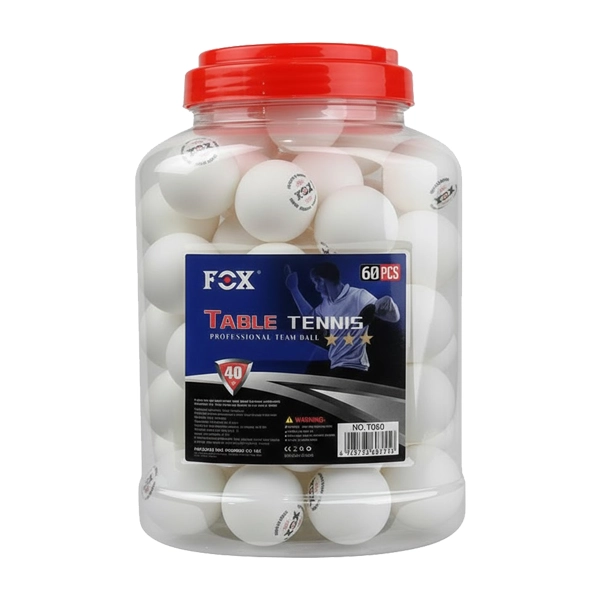
The 60-piece Fox table-tennis ball container is a Plus Fitness catalogue example for buyers considering a quantity of balls. Confirm the exact ball specification and intended use; the container quantity does not establish competition approval.
Browse the sports equipment range and ask about the current table, net and racket options rather than assuming a product photograph represents a complete package.
Compare delivery and assembly properly
Ask whether the quotation includes movement to the final room, assembly, levelling and a handover demonstration. Provide the route details before comparing delivery charges. A table’s folded size does not necessarily match the size of its shipping package. Use the delivery and handover checklist to confirm access, assembly and the supplied accessories. For a school purchase, include the table in the PE equipment plan so supervision, storage and replacement have named owners.
Confirm where packaging will be placed and who will remove it. Plan the receiving appointment with someone who can check the exact model, accessories and condition against the order.
If the room is upstairs, do not assume an ordinary passenger lift or a pair of staff can manage the equipment. The supplier should establish a suitable handling plan and identify any site requirements before delivery.
Give the table an operating routine
For a shared setting, name the person responsible for setup, storage, accessory counts and fault reporting. Keep the manual and supplier contact available. Report damage or a faulty lock before the table is moved or used again.
Use only the manufacturer-approved cleaning method for the playing surface. Do not apply a generic polish or abrasive cleaner because it is available in the office cupboard. Protect the table from unrelated uses that the manufacturer does not permit.
Review whether the table is actually accessible when people want to use it. If it remains folded behind furniture most of the time, the issue may be the room arrangement or setup process rather than lack of interest.
Make the enquiry specific
Send Plus Fitness the room dimensions, delivery route, intended users, indoor or outdoor conditions and whether folding storage is essential. Ask for the exact model’s dimensions in each state, included accessories, handling instructions and support terms.
Contact Plus Fitness about a table-tennis setup before committing to a model. A complete proposal should explain how the table arrives, where it plays, where it is stored and what users need for the first session.
Prepared with AI assistance. Sources and product links checked on 18 September 2026.
Leave a Reply