
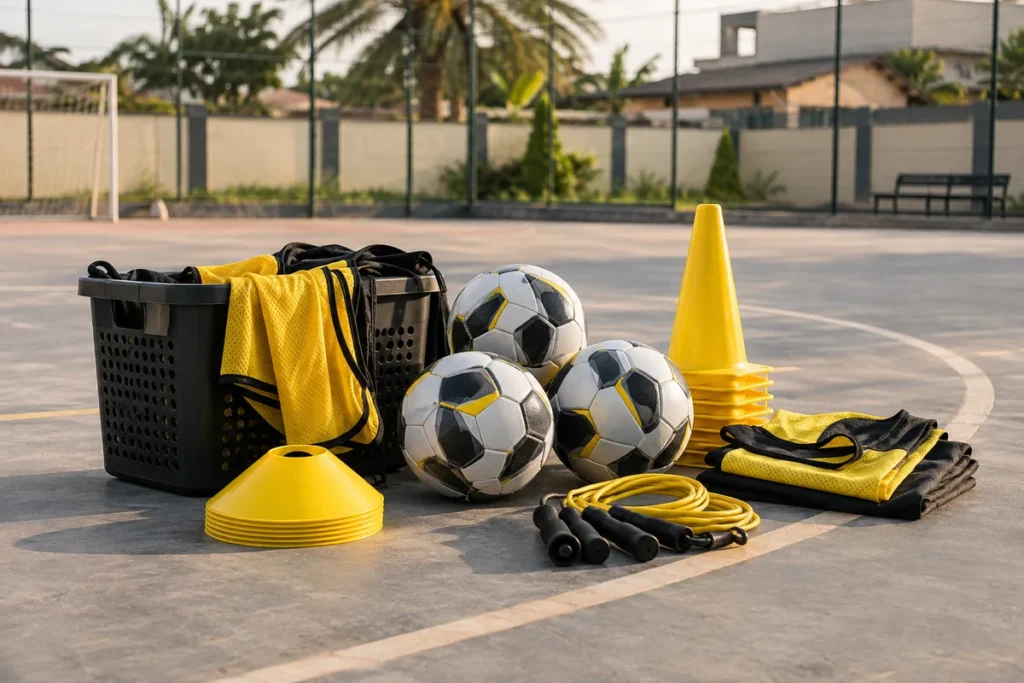
Featured image: AI-generated school-sports illustration; not a real school installation or supplied project.
Build a school sports kit from the activities teachers will deliver, the pupils who will use it and the space available. Buy enough suitable equipment for useful participation, then budget for storage, care and replacement. A long list of different products is not necessarily a better PE provision.
For a school in Nigeria, the practical starting point is a lesson plan and an inventory—not a bulk-order discount. This guide helps a PE lead or administrator turn those needs into a clear purchasing request.
Audit what the school already owns
Count the equipment, record its condition and separate usable items from those awaiting assessment or replacement. Note missing parts and accessories. A box containing ten balls is not a usable set of ten if several will not hold pressure or are the wrong size for the planned activity.
Ask teachers which items are used regularly, which cause delays and which remain in storage. Record the reasons. Equipment may be unused because it is unsuitable, incomplete, difficult to retrieve or unrelated to current lessons.
Do not make the inventory a test of staff memory. Check the actual store, identify the person responsible for it and keep the record simple enough to update when items move between classes or locations.
Translate lessons into quantities
Start with the activities and group arrangements the PE lead intends to use. If an activity uses one ball per pair, the equipment requirement follows from the number of participating pairs. If it uses small groups at stations, calculate each station separately.
For example, an illustrative class of 30 pupils working in pairs would need 15 balls for an activity requiring one ball per pair. That arithmetic is not a recommendation that every lesson should use that format. The teacher decides the appropriate activity and supervision.
Include the equipment needed to organise participation, such as suitable markers or bibs where relevant. Do not assume a small number of specialist items will keep a large class meaningfully involved without a plan for rotation and waiting time.
Choose age- and activity-appropriate specifications
Record the required size, weight, material and intended surface for each item. Use the teacher’s programme and the relevant sport or competition requirements. Do not apply adult match specifications automatically to younger pupils. Use the activity-specific guides when writing each part of the order: football boots and playing surfaces, footballs and inflation checks, table-tennis room planning, and beginner swimming kit. Each addresses different fit, space or supervision questions that a generic equipment bundle can miss.
For football, IFAB’s Law 2 defines the ball for the game governed by those laws. School and youth activities may use different approved sizes or formats, so confirm the relevant organiser’s requirements before buying in bulk.
For equipment that needs fitting, such as footwear or protective items, establish how individual fit will be checked. Ordering one size because it fits the oldest pupils is not a substitute for a fitting process.
Buy for the actual surface and storage conditions
Describe where lessons take place: grass, an artificial pitch, a hard court, an indoor hall or a combination. Ask the supplier to confirm that the exact product is intended for those conditions. “Outdoor” should not be treated as a promise that an item tolerates every surface or exposure.
Also describe where the equipment will be kept. A secure, accessible store helps teachers use what has been purchased. Plan how wet or cleaned items will dry according to their instructions before storage, and keep pathways clear.
Large or fixed equipment requires a separate installation and safety discussion. Portable goals, posts and similar items should be selected, installed, secured and used according to the manufacturer and the competent people responsible. Do not include an unverified anchoring method in an ordinary shopping list.
Separate the opening kit from later additions
Use three purchasing groups. The first contains equipment needed to deliver the planned lessons. The second contains replacements and supporting accessories that keep those lessons running. The third contains additions for activities the school has not yet committed to deliver.
This makes a constrained budget easier to use. Reducing the range of activities at the first purchase can be more sensible than buying an incomplete set for every sport. Explain that trade-off to the people approving the order.
| Purchasing group | Example decision |
|---|---|
| Core lesson kit | Enough suitable items for the planned group activities |
| Supporting kit | Storage, pumps or other accessories required by the selected equipment |
| Replacement allowance | A documented process for replacing lost or unserviceable items |
| Later expansion | Equipment for a new activity once teaching, space and storage are ready |
The examples describe a planning method, not a prescribed school equipment standard.
Write a specification that prevents substitutions by appearance
For each line, state the activity, required specification, quantity and whether a substitute must be approved. Include accessories and packaging or storage requirements where they matter. Ask for a sample or demonstration when a large order depends on fit or material suitability.
Avoid descriptions such as “good footballs” or “strong rackets”. They leave too much room for disagreement. A clearer line identifies the intended age group and surface, the required size or specification, the quantity and the information the supplier must confirm.
The Plus Fitness sports range provides a starting point for current catalogue options. Confirm the exact products and quantities in a written quotation rather than assuming a pictured collection is sold as one complete set.
Check the full cost and the receiving process
Compare equipment, accessories, delivery and any installation separately. Confirm where delivery ends and who will receive the goods. Ask how shortages, damage or an incorrect specification should be reported.
At receipt, count items against the order and check the agreed sizes and models before distributing them. Keep the invoice, product instructions and relevant warranty information. Record which items have been assigned to each store or team.
If a substitute arrives, have the authorised PE lead assess it before treating it as equivalent. A similar colour or brand does not establish that it meets the intended activity or surface requirements.
Give care and replacement a named owner
Agree who checks equipment before use, who reports damage and who can remove an item from circulation. Follow product instructions and the school’s safeguarding and activity procedures. Equipment checks do not replace supervision or appropriate teaching.
Keep cleaning arrangements practical and product-specific. CDC guidance for athletic facilities provides a general reference for care of shared sports equipment. Use the equipment and cleaning-product instructions for the actual method; do not apply one chemical to every material.
Review the inventory at agreed points in the school’s calendar and before major activity changes. Record losses and faults without turning the process into blame. The aim is to understand what the next purchase must address.
A procurement brief for the supplier
Send the age groups, class sizes, planned activities, available surfaces, existing usable equipment and storage arrangements. Add the budget scope, required delivery location and the date by which a decision is needed. Identify who can approve substitutions.
Ask the supplier to separate confirmed specifications from items needing clarification. If the school cannot yet specify a ball size, table format or fitting requirement, resolve that with the responsible teacher or organiser before bulk purchase.
Contact Plus Fitness with your school sports brief for a current, itemised quotation. Start with the activities the school is ready to deliver and build a kit that staff can use, maintain and account for.
Prepared with AI assistance. Sources and product links checked on 18 September 2026.
Pingback: Table Tennis Room and Equipment Planning Guide