
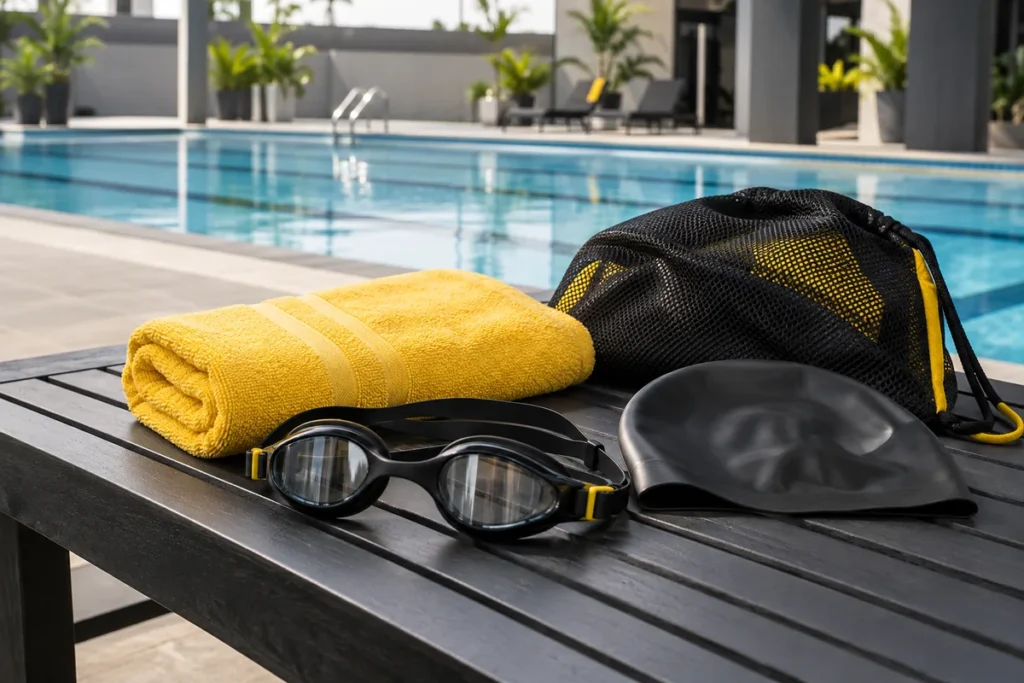
Featured image: AI-generated swimming-kit still life; accessories do not replace instruction or supervision.
For a beginner’s swimming lesson, start with suitable swimwear, well-fitting goggles if needed, a cap where required, a towel and a practical way to carry wet kit. Ask the instructor or venue what is necessary before buying optional training aids. Equipment can support a lesson, but it does not replace instruction or supervision.
Arm floaties are not life jackets or a safeguard against drowning. The CDC’s drowning-prevention guidance warns against relying on air-filled or foam toys as safety devices. Children require close, constant adult supervision around water, including when lessons or lifeguards are present.
Ask the venue before making a shopping list
Confirm the lesson format, pool rules and required kit. Some venues have requirements for caps, footwear around the pool or the type of swimwear permitted. Ask how changing, valuables and wet items are handled so you can prepare without buying unnecessary accessories.
For a child, establish who is responsible for supervision before, during and after the lesson. Do not assume that responsibility transfers simply because the family has entered the venue. Clarify the instructor’s arrangements and the parent or carer’s role directly.
For an adult beginner, tell the instructor about your experience and any relevant needs. If a health condition affects participation, seek appropriate healthcare advice. A retailer can explain equipment features, but should not determine whether a person is medically ready to swim.
Choose goggles by fit and intended use
Goggles need to fit the wearer’s face and adjust as the manufacturer intends. Where a fitting is available, check the seal, nose area, strap adjustment and comfort. Do not assume the tightest strap produces the best fit, or that an adult model will suit every face.
Ask whether the model is intended for an adult or child and what lens options are available. Choose with the actual pool environment and instructor’s advice in mind. A claim such as “anti-fog” is not a promise that goggles will remain clear under every condition or without appropriate care.
The Cima Adult Swim Goggles are one Plus Fitness catalogue option. Confirm the current model and fitting details before ordering. For children, ask for suitable options rather than selecting an adult pair solely because it is available.

Follow the manufacturer’s cleaning and storage instructions, especially for coated lenses. Avoid rubbing or applying household products to the inside of a lens unless the instructions permit it. Keep goggles protected in a suitable case or part of the bag so they are not damaged by other items.
Treat a cap as kit, not protective equipment
A swimming cap can help organise hair and meet a venue’s requirements. Choose the size and material according to fit, comfort and the product instructions. It should not be sold as a life-saving item or as a guarantee that hair or ears will remain completely dry.
Ask how to put it on and remove it without damaging the material. Long hair, head size and individual comfort can affect the choice. Do not assume one cap size suits everyone in a family or school group.
The Speedo Silicone Adult Swim Cap is a catalogue example to discuss with Plus Fitness. Confirm the exact product, current availability and whether its size is appropriate for the wearer.
Understand the limits of arm floaties
The Kids Arm Floaties listing is an example of an inflatable accessory. It must not be treated as evidence that a child can swim independently or that supervision can be reduced. Ask the instructor whether such an accessory has any role in the particular lesson.
Do not confuse an inflatable toy with a properly selected life jacket. Where a life jacket is required or recommended for the activity, obtain appropriate professional guidance on the suitable type, fit and applicable requirements. The CDC distinguishes life jackets from air-filled toys in its drowning-prevention advice.
A retail shopping list should keep those categories separate. Avoid phrases such as “drown-proof”, “safe without an adult” or “learn to swim automatically”. No accessory in this guide supports those claims.
Buy optional aids only for a defined purpose
Kickboards, pull buoys, fins and similar items may be used in instruction, but a beginner does not need to purchase every training aid before the first lesson. Ask what the instructor provides and what, if anything, the learner should own. A school or group can place the instructor’s requirements into the sports-equipment procurement plan. Where equipment is shared, the cleaning-routine guide explains how to organise product-specific instructions and responsibilities; the pool’s own requirements still apply.
For any recommended aid, confirm the size, intended user, use instructions and storage needs. A product used by an experienced swimmer in a video is not automatically appropriate for a new learner or a child.
For a school or group purchase, collect requirements from the people delivering the lessons before placing a bulk order. Separate individual-fit items from shared equipment and agree the care arrangements for each.
A practical first-lesson kit check
| Item | Decision before buying |
|---|---|
| Swimwear | Appropriate fit and venue requirements |
| Goggles | Suitable wearer, fit, lens use and care instructions |
| Cap | Venue requirement, size and comfort |
| Towel and bag | How dry and wet items will be kept separate |
| Poolside footwear | Venue rules and suitable use |
| Training aids | Only what the instructor recommends for a defined purpose |
Keep the list proportionate. A simple kit that fits and is easy to care for is more useful than an expensive bundle with unclear sizes or unnecessary accessories.
If a product is sold as a set, confirm exactly what is included. Photographs may show several colour or size options rather than the contents of one package. Ask the seller to identify the selected version on the order.
Plan care between lessons
Follow each item’s cleaning, rinsing, drying and storage instructions. Separate wet kit from items that need to remain dry, and avoid leaving equipment where it may be damaged by heat or other conditions outside the manufacturer’s guidance.
Check straps, seams and inflatable accessories for damage as directed before use. A damaged item should be removed from the kit until the appropriate next step is established. Do not improvise repairs to an item whose suitability depends on its original construction.
For broader pool-health considerations, consult the CDC’s healthy and safe swimming guidance and the venue’s current instructions. Buying goggles or a cap does not establish that a pool’s water quality or operating arrangements are appropriate.
Choose the lesson and the kit together
The instructor and venue should establish the learning environment and supervision arrangements. The equipment purchase should support that plan. Confirm required items first, fit them properly and learn how to care for them.
Browse Plus Fitness sports equipment or contact the team for help selecting goggles and caps. Share the wearer’s requirements and the instructor’s list, and ask for current product details rather than buying an accessory on the assumption that it provides water safety.
Prepared with AI assistance. Sources and product links checked on 18 September 2026.
Pingback: School Sports Equipment Buying Checklist in Nigeria