
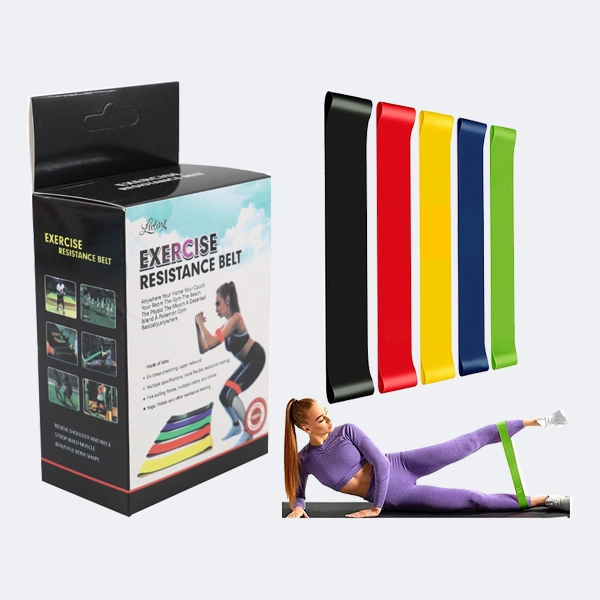
A green band from one brand may not provide the same resistance as a green band from another. Even a printed kilogram figure needs context: elastic resistance changes as the band stretches. To compare resistance band weight ratings, establish the product type, resting length and the stretch at which the manufacturer states its force.
Colour is useful for organising a particular range. It is a poor universal language for comparing unrelated products.
Why the same band feels harder later in the movement
Elastic resistance generally rises as the band is extended. The starting length and amount of stretch therefore affect the load experienced through the movement. Gripping a band differently can change the setup even when the band itself stays the same.
THERABAND's manufacturer guidance relates resistance to percentage elongation and explains comparisons within its own colour system. That does not establish a colour standard for every brand or material.
Percentage elongation describes how much the band has lengthened relative to its resting length. A piece that goes from 50 cm to 100 cm has increased by 100%. This arithmetic explains the term; it is not permission to stretch any band that far. The product's permitted extension takes priority.
Ask what the kilogram number means
A listing might give a resistance range, an approximate force at a stated extension or a total for several bands combined. Those descriptions are not interchangeable. If the measurement condition is missing, ask for it before comparing prices per kilogram of “resistance”.
For a set with attachable tubes, combining pieces is appropriate only where the system is designed for it and every component is compatible with the resulting use. The handle or anchor is part of the load path, not an incidental accessory.
Replace a band by specification rather than memory
When an old band needs replacement, keep its brand, model, type and resistance information. Note whether it was a long loop, flat strip, tube with handles or fabric mini-band. Two products sold for the same exercise can have different resting lengths and behaviours.
Try the new product according to its instructions and adjust the programme with appropriate guidance. Do not assume a matching colour reproduces the old load.
The existing resistance-band workout guide provides training context. Use the actual band's instructions for setup and inspection, especially when its construction differs from the examples in an exercise guide.
Inspect the full setup
Check for damage and deterioration using the manufacturer's guidance. Confirm that any anchor is designed for the task and that the supporting structure is appropriate. A door handle or convenient railing is not automatically a suitable anchor.
The doorway-equipment article explains why the strength of the supporting structure is a separate question from the rating of the exercise product. Do not knot, cut or modify a band to solve a fit problem unless that exact modification is permitted.
Make the comparison repeatable
Record the band identity, attachment points, starting length and exercise setup. This gives you a better basis for comparing sessions than a colour alone. For fixed external weights, the dumbbell-increment guide offers a different way to understand changes in resistance.
Plus Fitness lists loop resistance bands. Ask for the manufacturer's rating method, permitted extension, material and compatible anchoring instructions. A clear specification will help you select the right band far more reliably than choosing whichever colour looks familiar.
Pingback: Resistance Band Workouts for Beginners in Nigeria (Home + Apartment-Friendly) - Sports & Fitness Shop in Port Harcourt | Plus Fitness