
An exercise ball should be selected for the intended activity, the user's fit and the manufacturer's loading and inflation instructions. Its advertised diameter describes a size, not permission to keep adding air until it feels firm. An “anti-burst” or slow-deflate claim also needs a precise product definition.
A ball is a moving support surface. Treating it like an ordinary chair or a piece of solid gym furniture can lead to the wrong purchase and the wrong expectations.
Choose the activity before the diameter
Explain how the ball will be used and ask an appropriately qualified instructor to help assess size where necessary. A general height chart can create a shortlist, but it should not replace the activity-specific fit or the manufacturer's instructions.
For a group class, consider whether several sizes are needed. Buying one size in bulk may simplify ordering while making the session less suitable for some participants.
The THERABAND manufacturer catalogue distinguishes standard and slow-deflate exercise balls and lists different sizes. It also describes measuring equipment supplied with certain products. That is a useful reminder to identify the exact version rather than treating all coloured balls as equivalent.
Inflate to the instructions
Use the specified pump, adapter and measurement procedure. Some products have a staged inflation process or require time before final adjustment. Follow the supplied instructions rather than borrowing a routine from another brand.
Do not exceed the specified diameter to obtain a firmer feel. Check the plug and keep the appropriate removal tool and spare parts if supplied. An improvised sharp tool can damage the product during an otherwise simple task.
If the ball loses air unexpectedly or develops visible damage, stop using it and seek product-specific advice. Repeatedly topping it up does not explain the cause.
Read anti-burst as a defined claim
Ask what the manufacturer means by the term, what testing or conditions support it and what user or total-load limits apply. Slow deflation under specified conditions is not the same as being puncture-proof, indestructible or suitable for any added weight.
| Before purchase | Before use |
|---|---|
| Exact model and diameter | Correct inflation and plug condition |
| Intended activities | Clear floor and appropriate surrounding space |
| Applicable load limit | Visual inspection for damage |
| Meaning of any slow-deflate claim | Setup follows the instructor and product guidance |
Do not add external loads or use a ball as a replacement weight bench unless the manufacturer expressly permits that activity and the setup is appropriate. The load path and stability differ from solid equipment.
Give the ball a suitable home
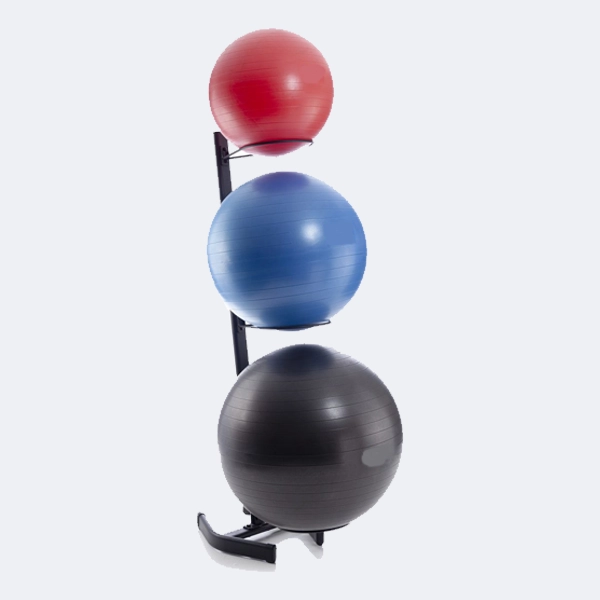
Keep the working area free of sharp objects and follow the storage instructions regarding heat, sunlight and other conditions. A rack or holder should prevent the ball from rolling into a walkway without squeezing or damaging it.
The gym-storage guide helps make room for larger accessories. The mat comparison explains why a soft exercise surface and a stable equipment floor are separate choices.
Ask for the complete kit
Plus Fitness lists exercise balls. Confirm the available sizes, included pump and accessories, inflation procedure and actual product claims. State whether the purchase is for individual exercise, a class or another supervised activity.
Include the ball and its storage in your gym setup brief. A small accessory can still need a meaningful amount of working space, especially when its normal use involves movement away from a fixed position.
Leave a Reply