
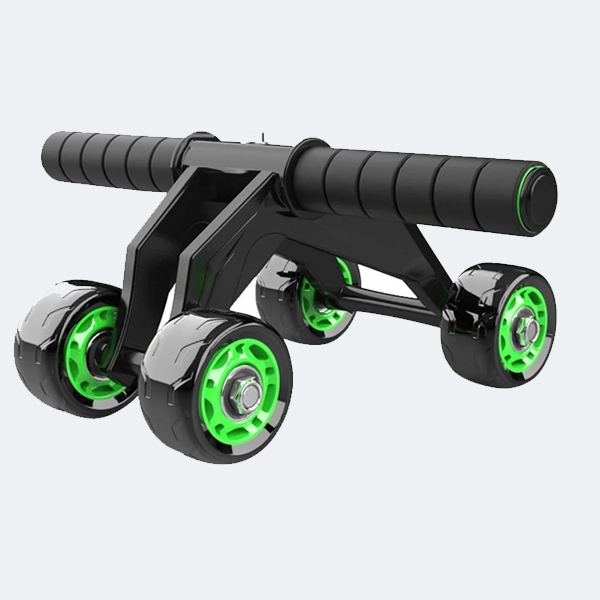
Choose an ab roller by its handling, wheel arrangement, assembly and suitability for your current exercise programme. More wheels may change stability, while an assistance mechanism changes how the product behaves. Neither feature guarantees that the exercise is appropriate for every user.
An ab roller is also not a device that selectively removes belly fat. Its value should be judged as exercise equipment, with realistic expectations about what a small accessory can do.
Start with the movement you can control
Ask a qualified instructor whether a rollout variation fits your present ability and how it should be introduced. The distance travelled is not a competition. If a movement causes pain or cannot be controlled appropriately, stop and seek suitable guidance.
A simpler exercise or a different piece of equipment may be the better starting point. Buying an assisted roller does not replace that decision.
Compare the wheel and handle arrangement
Look at the contact area, grip, axle arrangement and the manufacturer's permitted surface. A wide or multi-wheel design may behave differently from a narrow single wheel, but the quality of assembly and actual movement still matter.
Try the handle spacing and grip under guidance. Check that components fit securely as instructed and that the wheel moves as intended. Do not use an improvised replacement axle or assume a loose handle is harmless because the equipment is small.
| Feature | What to establish |
|---|---|
| Wheels | Intended movement and surface contact |
| Handles or supports | Comfortable fit and secure assembly |
| Assistance | What the mechanism does and its limits |
| User limit | Stated conditions for the exact product |
| Surface | Appropriate grip, stability and clear space |
Understand assistance before relying on it
Some products contain a spring or another return mechanism. Ask the supplier to demonstrate how it behaves, what adjustments are permitted and whether it requires any care. Avoid assuming that it will return the user safely from any position.
If a mechanism becomes unreliable, remove the equipment from use. General equipment-inspection guidance supports checking for deterioration, but the actual checks and any repair method must come from the product's documentation.
Give the exercise enough room
Clear the movement area of furniture, loose objects and other people. The chosen surface should follow the manufacturer's instructions and support the intended setup. A mat used for comfort must not create an unstable or obstructed rolling path.
The yoga-mat and exercise-mat comparison helps distinguish cushioning from stability. If considering other accessories, the exercise-ball guide explains another product whose size and support behaviour require more thought than its compact price suggests.
Keep the purchase proportionate
A roller can be a useful addition to an appropriate programme, but it does not make a complete strength setup by itself. If your budget is limited, discuss priorities with a coach and compare the equipment needed for the movements you intend to practise.
The existing weight-bench guide offers context for a broader setup. Buy an accessory because it fills a real gap, not because a dramatic before-and-after claim promises a shortcut.
Plus Fitness lists a four-wheel ab roller. Request the assembly instructions, user limit, surface guidance and details of any assistance feature. A sensible purchase is one whose operation you understand and whose use fits an appropriate programme.
Leave a Reply