
Featured image: AI-generated bench-detail illustration; the linked catalogue product is shown separately.
A weight bench should fit the user, the exercises and the equipment around it. Check stability, adjustment security, dimensions and the meaning of the manufacturer’s load rating before focusing on the number of positions or the appearance of the frame.
A bench that suits dumbbell work in a small home may not suit barbell work inside a particular rack. The most useful purchase is one whose capabilities and limits are documented for the setup you intend to use.
Choose the functions you actually need
A flat bench has a fixed support surface. An adjustable bench changes the backrest and sometimes the seat angle. Some benches include decline positions or attachments, but those features vary by model and should not be assumed from the word “adjustable”.
List the activities the bench must support and the positions required. If you do not need an attachment, do not let it outweigh more basic questions about fit, stability and support. If a particular angle matters, ask for the documented adjustment range rather than judging it from a photograph.
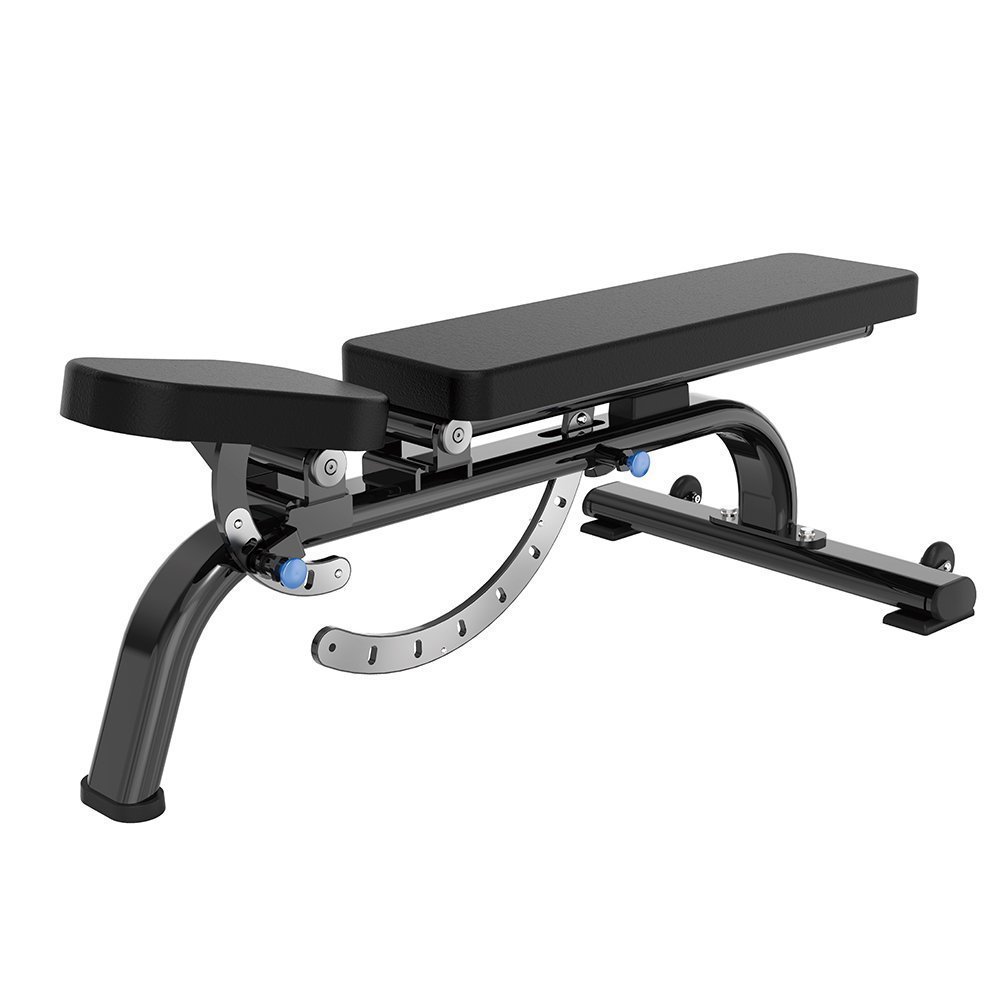
The Adjustable Bench in the Plus Fitness catalogue is listed with flat, incline and upright positions. Before buying, request the exact model confirmation, dimensions, load limits and permitted use. Those details should be established in writing rather than inferred from the product image.
Understand the load rating
Ask whether the stated limit refers to user mass, external weight or a combined load. Confirm whether it applies in every position and with every attachment. A single number in a listing may not answer those questions.
For example, a hypothetical 250 kg combined limit would need to account for the user and the relevant external load under the manufacturer’s definition. It would not mean a 250 kg external weight can be added regardless of the user. This example explains the distinction; it is not a rating for any Plus Fitness bench.
Do not conduct your own maximum-load test. Request the manufacturer’s documentation and choose within the stated conditions, with appropriate training guidance for the activity. “Heavy duty” and a large frame are not substitutes for a specification.
Check fit in the intended positions
Where a demonstration is available, assess the bench using the positions you plan to use. Consider the height, support-pad width and length, the gap between pads and whether you can set up comfortably according to appropriate exercise guidance.
There is no one bench dimension that suits every person and movement. A broad pad may feel supportive in one position but restrict another user’s movement. A tall bench may present a different setup problem from a lower one. A qualified coach can help assess fit for the exercises; the equipment supplier should establish the bench’s specifications and limits.
If the bench will be shared, consider the range of users rather than the project buyer alone. Clear adjustment markings and an understandable mechanism become particularly useful when people change settings frequently.
Examine stability and adjustment security
Ask the seller to demonstrate how the adjustment mechanism engages and how a user confirms it is correctly set. Pins, ladders and other locking arrangements must be used as designed. Do not accept a demonstration that relies on a partly engaged setting or a missing component.
Check that the bench stands as intended on a suitable surface. Movement may come from the floor, an incorrect assembly or the equipment itself; the cause should be resolved, not hidden beneath an improvised wedge. Follow the manufacturer’s levelling and installation instructions where provided.
For used equipment, visible cracks, damaged welds, loose joints or a malfunctioning adjustment system require competent assessment. Do not buy on the assumption that a quick weld or replacement pin of similar size will preserve the original rating.
Match the bench to the rack
If you plan barbell exercises, assess the bench and rack together. The bench must be positioned appropriately without its frame or feet conflicting with rack crossmembers or other components. The rack’s supports and safety arrangements need to suit the activity and the user’s setup. Check the complete arrangement with the rack space and compatibility guide, then compare the dumbbell options you expect to use. A second-hand bench also needs the identity, condition and support checks in the used-equipment guide.
A bench fitting between two uprights is only the first check. Confirm the usable positioning range and the relevant manufacturer’s instructions. Do not assume that buying both items from the same shop automatically makes every combination compatible.
Measure the operating area with the bench in position, including access around it and room for adjustments. Keep the manufacturer’s required clearances and the building’s circulation arrangements in the plan.
Think through moving and storing it
Wheels and handles can make repositioning easier, but the method and limits still depend on the model. Ask how the bench should be moved and whether it is designed for upright or folded storage. A photograph of a bench standing on its end does not establish that storage position as safe.
If a folding bench is being considered for a home, confirm the folded dimensions and the locking process. Check how it will be kept secure when not in use, especially in a household where others may enter the storage area.
For a shared facility, frequent movement may create more work than the layout suggests. A bench that is moved repeatedly to open a cupboard or release a walkway may indicate a room-planning problem rather than a need for better wheels.
Compare upholstery, maintenance and support
Inspect the upholstery and seams, and ask for the approved cleaning method. Avoid choosing a material solely because it looks easy to wipe. Cleaning-product compatibility matters, particularly where staff clean equipment frequently.
Ask whether replacement pads, adjustment components and other service parts can be obtained for the exact model. Record the support channel and product-specific warranty terms. The Plus Fitness warranty and returns policy should be read alongside those terms.
Maintenance should follow the manufacturer’s instructions and be carried out by people competent for the task. HSE’s maintenance guidance is a useful general reference for that approach. It does not justify applying a generic tightening schedule or torque value to every bench.
A comparison card for your shortlist
| Question | What to record |
|---|---|
| Which positions are required? | Documented positions and adjustment range |
| Will it fit the users? | Height, pad dimensions and demonstrated setup |
| What does the rating cover? | User, external or combined load; position restrictions |
| Will it work with the rack? | Exact models and confirmed positioning compatibility |
| How is it adjusted? | Engagement check and required components |
| How will it be stored? | Approved storage position and dimensions |
| What support is available? | Manual, warranty conditions and replacement parts |
Reject an incomplete comparison where one bench has confirmed information and another is described only as “commercial quality”. Ask for the missing evidence before deciding that the second one is equivalent.
Make the purchase fit the room
If space is tight, review the whole strength area before ordering. The guide to a small-apartment gym can help you consider storage and use together. Browse strength equipment for the available options, then narrow the choice by confirmed fit and function.
Contact Plus Fitness with the exercises or positions you need, the intended users and any rack model already owned. Ask for a demonstration where available and written confirmation of the specifications that matter to your purchase.
Prepared with AI assistance. Sources and product links checked on 18 September 2026.
Leave a Reply