
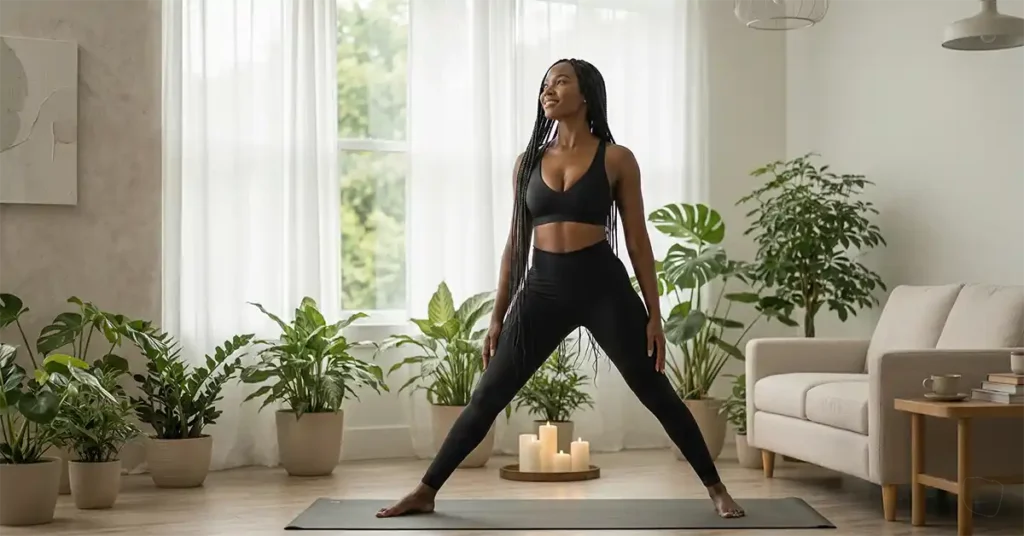
Between the traffic in Nigeria, looming work deadlines, and just… the general hustle of life in Nigeria, do you ever feel like you need to hit a reset button? While a high-intensity workout is fantastic, sometimes what your mind and body truly crave is a moment of calm, a deep stretch, and a chance to just breathe.
Welcome to the world of yoga and wellness.
Forget the intimidating images of super-flexible gurus in impossible poses. At its heart, yoga is a practice for everyone. It’s about connecting with your body, improving your flexibility, and finding your calm amidst the chaos. This guide will show you how simple it is to start right in your living room.
Your Quick Start Guide to Yoga
- You Don’t Need to Be Flexible: This is the biggest myth. Yoga is the practice that builds flexibility. You start from where you are.
- A Good Mat is Key: This is your sacred space. Investing in a quality, non-slip yoga mat is the most important first step.
- Start with 10-15 Minutes: You don’t need an hour. A short, consistent daily practice is more beneficial than one long session per week.
- It’s Not Just a Workout, It’s a “Work-In”: Yoga benefits your mind just as much as your body, helping to reduce stress and improve focus.
More Than Just Stretching: Why Yoga is a Game-Changer
While yoga and wellness is famous for improving flexibility, the science-backed benefits run much deeper, making it a perfect complement to any fitness routine.
- Reduces Stress & Anxiety: Yoga and Wellness practice has been shown to help reduce the secretion of cortisol, the primary stress hormone in the body [1]. It’s a powerful tool for managing the pressures of a busy Nigerian life.
- Improves Posture & Reduces Back Pain: Many of us spend hours sitting—at a desk, in a car. Yoga and wellness strengthens your core and back muscles, helping to correct slouching and alleviate common aches and pains.
- Enhances Flexibility & Balance: This is the most obvious benefit. Improved flexibility reduces the risk of injury in your other physical activities, from running to lifting weights.
- Boosts Overall Well-being: By focusing on mindful movement and breath, yoga offers a unique way to connect with your body, which can improve your mood and overall sense of wellness. As noted in our Guide to Realistic Weight Loss for Busy Nigerians, managing stress is a key component of a healthy lifestyle.
Your First Yoga Session: 4 Simple Poses to Start Today
You don’t need to twist yourself into a pretzel. Master these four foundational poses to begin your journey. Find a quiet corner—our guide to creating a home gym in a small apartment has tips for this—and let’s begin.
- Cat-Cow Stretch (Marjaryasana-Bitilasana):
- Start on your hands and knees, with your wrists under your shoulders and knees under your hips.
- Cow: Inhale as you drop your belly towards the mat, lift your chest and chin, and look up.
- Cat: Exhale as you round your spine toward the ceiling, tuck your chin to your chest, and press the mat away from you.
- Repeat for 5-8 breaths. This is a perfect warm-up.
- Downward-Facing Dog (Adho Mukha Svanasana):
- From all fours, tuck your toes, lift your hips up and back, forming an inverted V-shape with your body.
- Gently press your heels toward the floor (they don’t need to touch). Let your head hang heavy between your upper arms.
- Hold for 5 deep breaths.
- Warrior II (Virabhadrasana II):
- Step your feet wide apart. Turn your right foot out 90 degrees and your left foot in slightly.
- Bend your right knee until it’s directly over your ankle, keeping your left leg straight.
- Extend your arms parallel to the floor, gazing over your right fingertips.
- Hold for 5 breaths, then switch sides.
- Child’s Pose (Balasana):
- Kneel on the floor, sit back on your heels, then fold forward, resting your torso between your thighs and your forehead on the floor.
- Your arms can be stretched forward or resting alongside your body.
- This is a resting pose. Stay here for as long as you like. It’s a fantastic cool-down after any workout, including those in our Beginner’s 30-Day Workout Plan.
Your Yoga and Wellness Starter Kit
While you can start with just your body, having the right gear makes the practice safer, more comfortable, and more effective. It doesn’t require a huge budget.
1. The Essential: A Quality Yoga Mat
- Approximate Cost: ₦12,000 – ₦25,000
- Why it’s a non-negotiable: An exercise mat is fine, but a true yoga mat is designed for grip. A good non-slip surface is crucial for holding poses like Downward-Facing Dog safely. Look for one that’s about 5-6mm thick for a good balance of cushioning and stability.
2. The Supporter: A Pair of Yoga Blocks
- Approximate Cost: ₦8,000 – ₦15,000 for a pair
- Why they help: Blocks are not a sign of weakness; they are a sign of wisdom. They act as extensions of your arms, bringing the floor closer to you in certain poses. This helps you maintain proper alignment and get the full benefit of a pose without straining.
3. The Recovery Tool: A Foam Roller
- Approximate Cost: ₦10,000 – ₦20,000
- Why it’s a game-changer: This is where wellness meets fitness. A foam roller is used for self-myofascial release—a form of self-massage to release muscle tightness or trigger points. Rolling out your muscles after a tough workout (especially after a session from our Strength Training 101 Guide can help reduce soreness and speed up recovery.
Frequently Asked Questions (FAQs)
1. What’s the difference between a yoga mat and a regular exercise mat? Yoga mats are typically thinner and have a much stickier, gripper texture to prevent your hands and feet from slipping during poses. Exercise mats are often thicker to provide more cushioning for high-impact moves.
2. Can yoga help me lose weight? Yes, it can. While it may not burn as many calories as a high-intensity cardio session on a Treadmill or Elliptical, a consistent yoga and wellness practice (especially more active styles like Vinyasa) builds lean muscle and boosts metabolism. More importantly, it promotes mindfulness, which can lead to healthier eating habits.
3. I’m not religious. Can I still do yoga? Absolutely. While yoga has spiritual roots in ancient India, the way it is practiced by most people today is as a form of physical and mental exercise. It is a practice for everyone, regardless of your beliefs.
4. How often should I practice as a beginner? Aim for 10-20 minutes, 3-4 times a week. Consistency is far more important than the length of your sessions.
The Bottom Line
Yoga and wellness are not about achieving a perfect pose; they are about creating a better connection with your body and finding a sense of balance in a busy world. By starting with simple poses and investing in a few key pieces of gear, you can build a practice that reduces stress, improves your physical health, and serves as a perfect complement to all your other fitness goals.
Start Your Wellness Journey Today
Shop Yoga Mats, Blocks, and Wellness Essentials
Have questions about where to begin? Book a Free Consultation with Our Fitness Experts
Citations
[1] Pascoe, M. C., et al. (2017). The effect of yoga on the autonomic nervous system and allostatic load in a young, healthy population: A pilot study. Journal of Evidence-Based Integrative Medicine, 22(4), 589–596. Retrieved October 11, 2025, from https://www.ncbi.nlm.nih.gov/pmc/articles/PMC5871181/